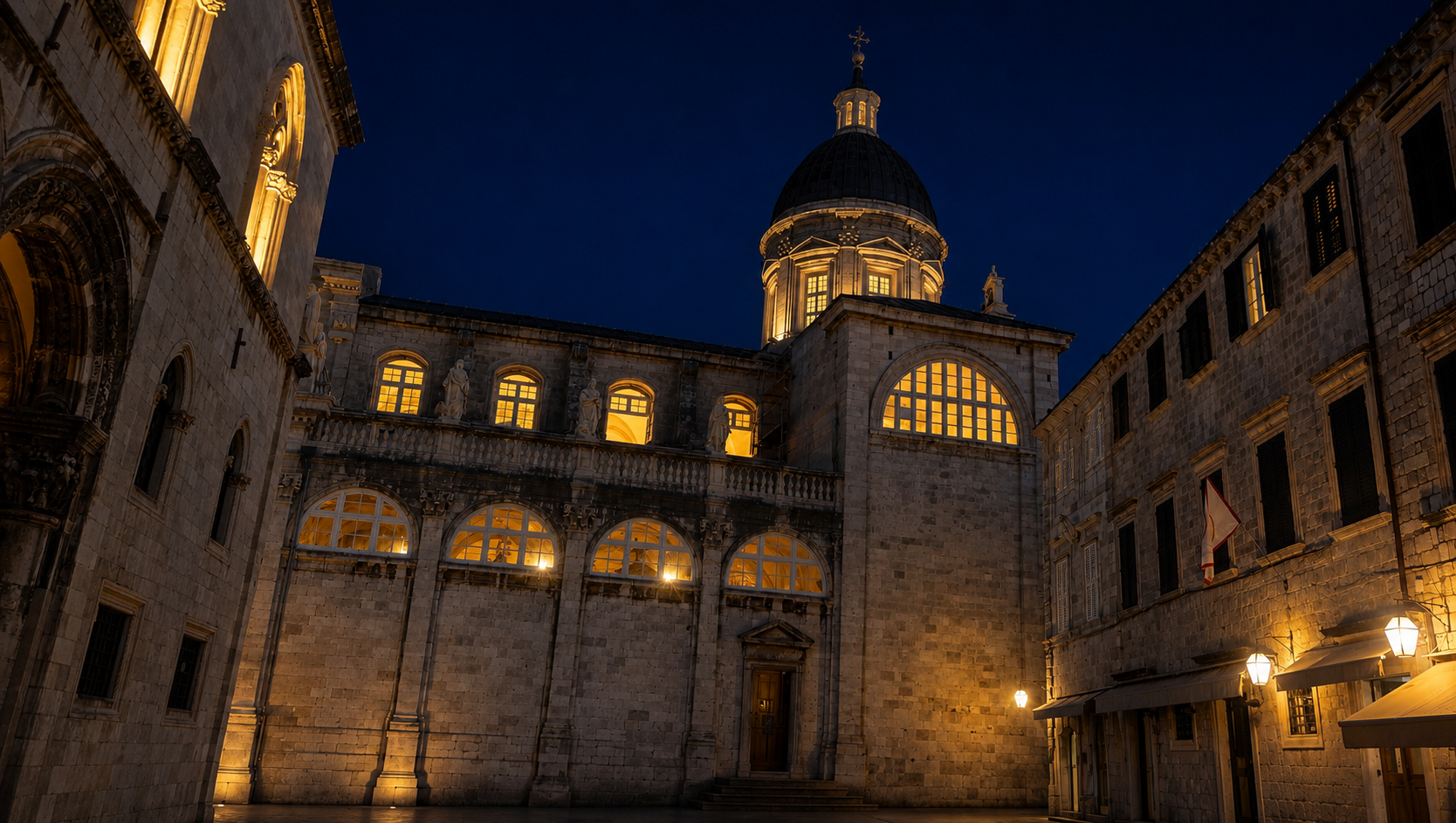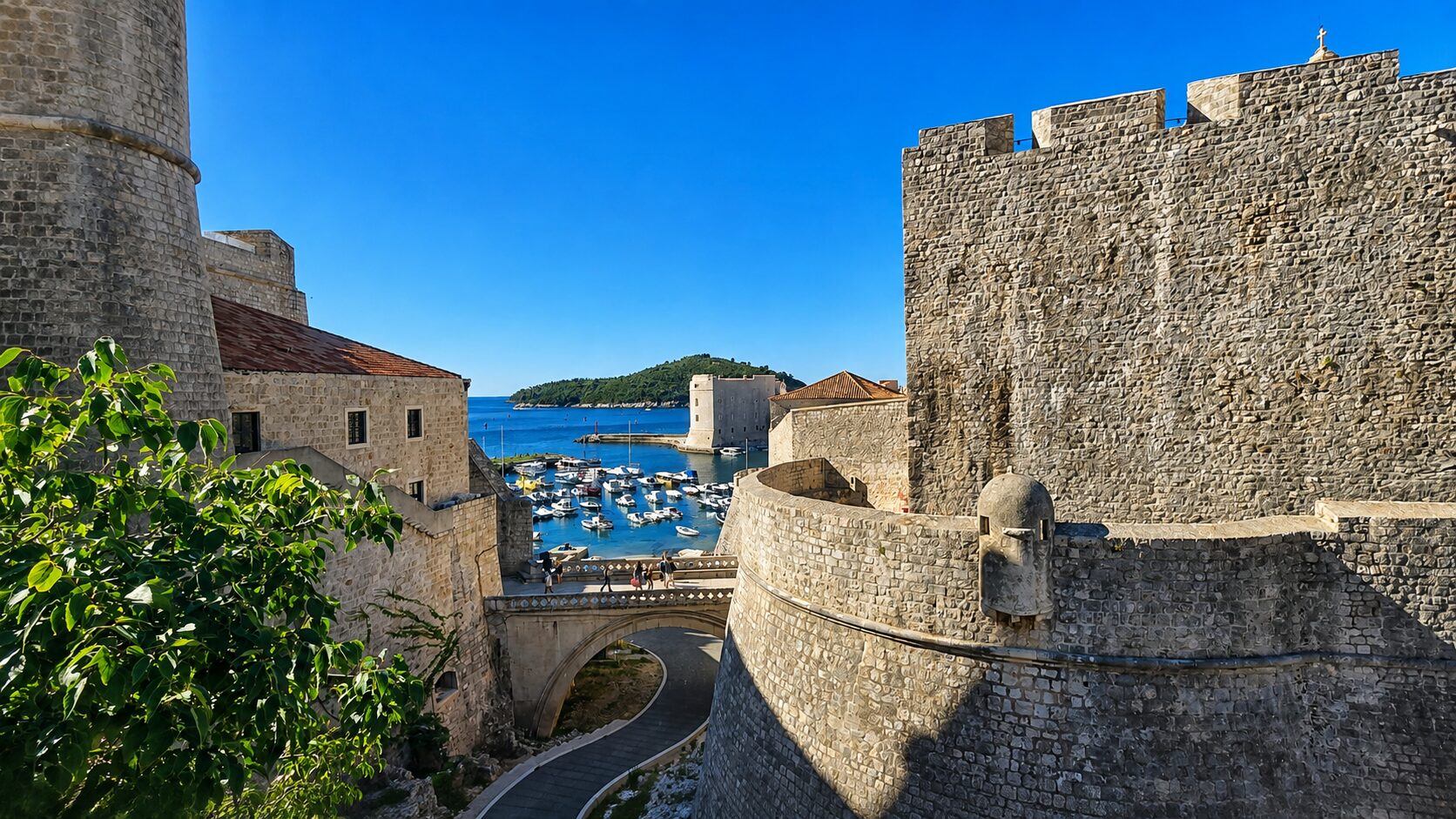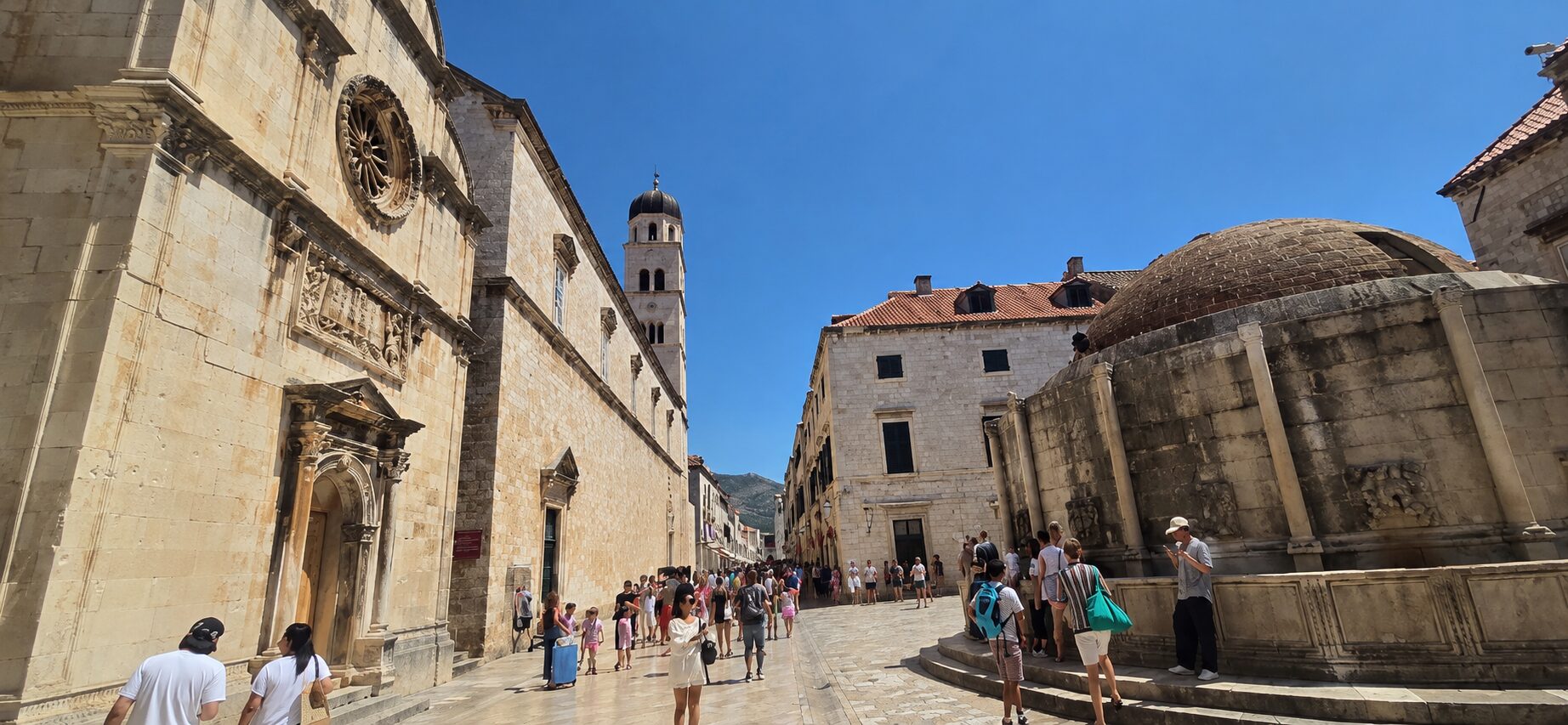
Stradun is Dubrovnik’s famous main street and the heart of its UNESCO-listed Old Town. Nearly every visitor walks its 298 metres, but many miss the stories, familiar local people and traditions hidden behind its polished limestone pavement.
I am Ajla Hadžić, a licensed Dubrovnik local guide and founder of VipWalk Dubrovnik, and after more than ten years of guiding guests here, I have learned that many of Stradun’s most interesting stories are hidden in details people pass without noticing.
This is the route I naturally follow with my own guests—from Pile Gate to Luža Square, with historic landmarks, useful stops, local craftspeople and familiar faces who help keep the historic centre alive.
You can walk from one end of Stradun to the other in approximately ten minutes. To understand what you are seeing, meet some of the people connected with the street and explore its most important stops, allow between 60 and 90 minutes.
Visitors exploring Dubrovnik for the first time may also find my complete guide to Dubrovnik walking tours useful for understanding how Stradun connects with the wider walled city.
What You Will Discover in This Guide
Along this route, you will discover:
- where to refill your water bottle before walking the City Walls;
- where to find handmade souvenirs and traditional Konavle embroidery;
- who sells the small Dubrovnik Heart for only a few euros;
- where to enter the main section of the Dubrovnik City Walls;
- how to visit one of Europe’s oldest continuously operating pharmacies;
- where a Dubrovnik family has been making gelato since 1968;
- which cafés offer a front-row view of Stradun;
- which architectural and historical details most visitors walk past.
What Makes This Stradun Guide Different?
Most guides concentrate almost entirely on monuments. They mention Large Onofrio’s Fountain, the Franciscan Monastery, the polished limestone pavement and the Bell Tower.
All of those places are important, but they are not the complete story.
Stradun is also shaped by people such as Ankica, who sells handmade embroidered pieces near Pile Gate, and Mirso, whose cheerful presence and small Dubrovnik Heart have made him one of the familiar faces of this entrance to the Old Town.
This guide combines history with practical advice, independent businesses, personal recommendations and details gathered through years of walking this route with visitors.
Contents
- Stradun essential information
- Before you start
- Stradun walking map
- Quick stops along Stradun
- What is Stradun in Dubrovnik?
- Entering through Pile Gate
- Ankica and her handmade souvenirs
- Mirso and the Dubrovnik Heart
- Large Onofrio’s Fountain
- Dubrovnik City Walls entrance
- Franciscan Monastery and Pharmacy
- Gelateria Dubrovnik
- Cafés and restaurants
- Bell Tower and Luža Square
- Best photo spots
- Recommended walking times
- Seasonal advice
- Information for senior travellers
- Information for cruise guests
- Frequently asked questions
Stradun Dubrovnik: Essential Information
| Practical detail | Information |
|---|---|
| Historical and official name | Placa, commonly known as Stradun |
| Length | 298 metres |
| Starting point | Pile Gate and Large Onofrio’s Fountain |
| Finishing point | Luža Square and the Bell Tower |
| Direct walking time | Approximately 10 minutes without stops |
| Recommended visit | 60–90 minutes |
| Surface | Mostly flat, smooth limestone |
| Best time | Early morning or later in the afternoon |
| Suitable for | First-time visitors, families, senior travellers and cruise guests |
Before You Start
A few simple details can make your Stradun walk more comfortable:
- Start early during summer for cooler temperatures and fewer people.
- Bring a refillable water bottle. You can refill it at Large Onofrio’s Fountain.
- Wear shoes with a good grip, especially after rain. The polished limestone can become slippery.
- Expect the largest crowds around Pile Gate and the western end of Stradun.
- Allow more time than the street’s short length suggests. Its most interesting details are discovered by stopping.
Local Tip
During the main summer season, try to enter through Pile Gate before the largest cruise groups arrive. Early morning gives you more space to notice the architecture and photograph the street, while late afternoon brings softer light and a more relaxed atmosphere.
Cruise passengers with limited time can also read my guide to spending four hours in Dubrovnik from a cruise ship before planning their visit.
Stradun Walking Map: Pile Gate to Luža Square
How to use this guide: Follow the numbered route from Pile Gate to Luža Square. Allow 60–90 minutes for the principal stops. Stradun itself is predominantly flat and suitable for families, senior visitors and most wheelchair users, although individual attractions may contain steps.
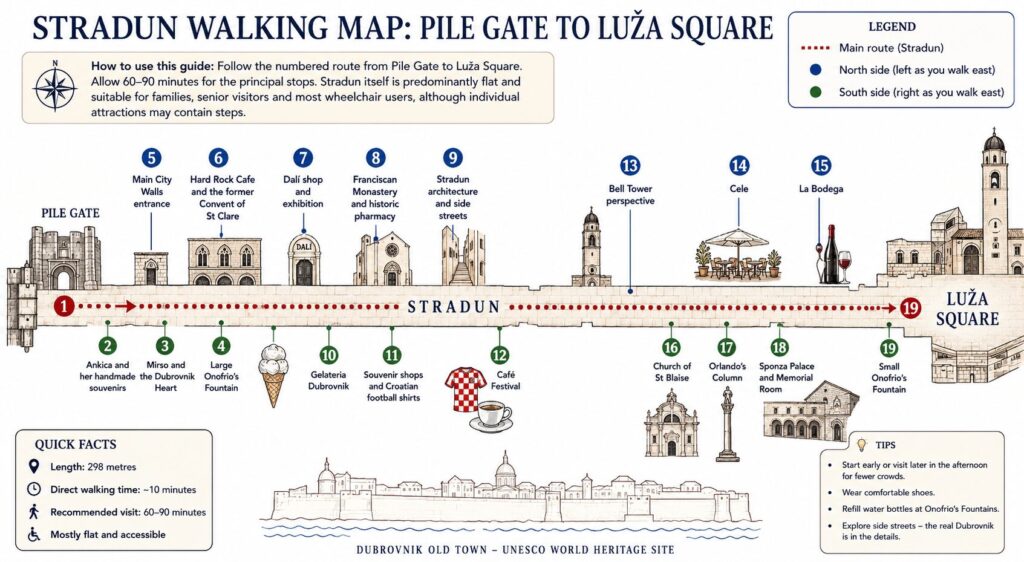
Quick Stops Along Stradun
| Stop | What to see | Suggested time |
|---|---|---|
| 1 | Pile Gate | 5–10 min |
| 2 | Ankica’s handmade souvenirs and Konavle embroidery | 5–10 min |
| 3 | Mirso and the Dubrovnik Heart | 5 min |
| 4 | Large Onofrio’s Fountain | 5–10 min |
| 5 | Main City Walls entrance | 5 min |
| 6 | Hard Rock Cafe and former Convent of St Clare | 5–15 min |
| 7 | Dalí shop and exhibition | 5–20 min |
| 8 | Franciscan Monastery and Pharmacy | 10–30 min |
| 9 | Stradun architecture and side streets | 5–10 min |
| 10 | Gelateria Dubrovnik | 10–15 min |
| 11 | Souvenirs and Croatian football shirts | 5–15 min |
| 12 | Café Festival | Optional break |
| 13 | Bell Tower perspective | 5 min |
| 14 | Cele | Optional break |
| 15 | La Bodega | Optional break |
| 16 | Church of St Blaise | 5–10 min |
| 17 | Orlando’s Column | 5 min |
| 18 | Sponza Palace and Memorial Room | 10–20 min |
| 19 | Small Onofrio’s Fountain | 5 min |
You can complete the essential route in approximately 30 minutes. Allow 60–90 minutes to include the main landmarks, independent businesses and photographs, or around two hours if you enter the monastery and stop for coffee or gelato.
What Is Stradun in Dubrovnik?
Stradun, historically and officially known as Placa, is the broad pedestrian street running through the centre of Dubrovnik Old Town. It extends from the area beside Pile Gate and Large Onofrio’s Fountain to Luža Square, the Bell Tower and the passage leading toward the Old Port.
The street is almost entirely level, making it one of the easiest parts of the historic centre to explore. This is especially helpful for families, senior travellers and visitors who would prefer not to climb Dubrovnik’s many stone stairways.
Stradun developed over an area that once separated two early settlements. Over time, the channel was filled and transformed into the city’s central commercial and public avenue.
Its present uniform appearance is largely connected with the reconstruction that followed the devastating earthquake of 1667. Businesses historically occupied the ground floors, while families lived above them.
Stradun was never simply a beautiful street. It was an organised commercial centre, a ceremonial space and the principal everyday route through the city.
Today, Stradun remains Dubrovnik’s main meeting place, ceremonial street and everyday route through the Old Town.
1. Entering Old City Through Pile Gate
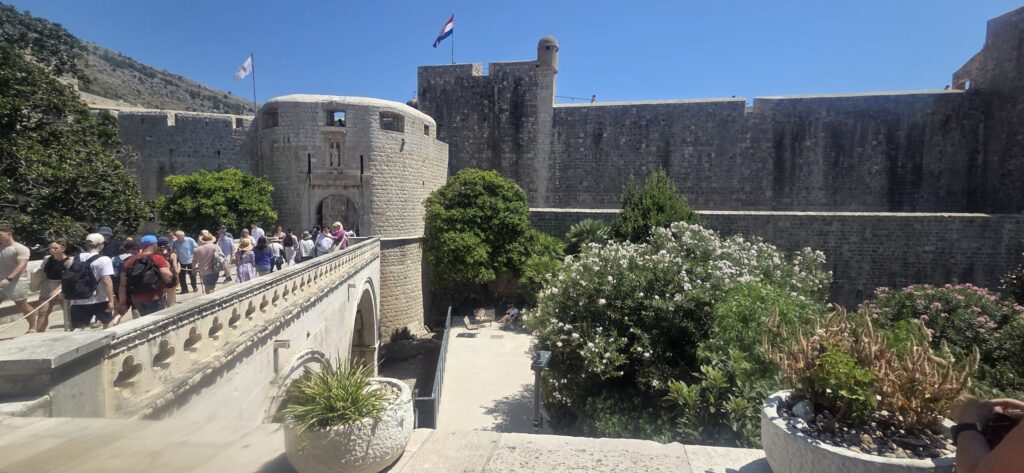
For most first-time visitors, Pile Gate is the principal entrance into Dubrovnik Old Town.
Before entering, notice that it is not simply one large doorway. You cross a stone bridge and pass through a sequence of gates, passages and defensive spaces. The route changes direction as you move through it, preventing a direct approach into the city.
Above the entrance, a statue of St Blaise watches over Dubrovnik. You will see the city’s patron saint represented throughout the historic centre, usually holding a model of Dubrovnik in his hand.
When I meet guests at Pile Gate, I normally use these first moments to explain the basic layout of the city. Stradun forms the central line. The northern streets rise steeply uphill, while the southern side leads toward squares, quieter streets and the sea-facing section of the walled city.
Pile Gate becomes extremely busy when cruise excursions and organised groups arrive at similar times. Move away from the narrow passage before stopping for photographs or opening a map.
Visitors arriving from a cruise ship should remember that Pile is normally the closest vehicle drop-off point to this side of the historic centre. My guide to travelling from the Dubrovnik Cruise Port to the Old City explains the difference between arriving in Gruž Harbour and arriving by tender near the Old Port.
Local Tip
After entering, move a few metres away from the narrow passage before stopping. This keeps the entrance clear and gives you a better view back toward the defensive gateway.
2. Meet Ankica, a Local Craftswoman Near Pile Gate
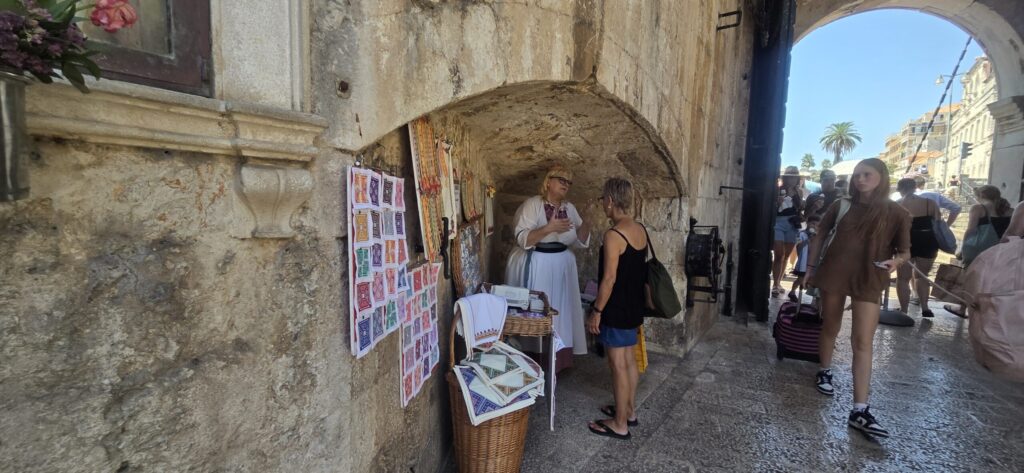
As soon as you pass through Pile Gate, look to your right.
Here you will find Ankica, a Dubrovnik craftswoman who sells handmade souvenirs, decorative tablecloths and textile pieces featuring traditional Konavle embroidery.
Konavle embroidery comes from the region south of Dubrovnik and is recognised by its precise geometric patterns and traditional colours. It represents a genuine regional craft rather than a standard Dubrovnik image printed on an imported product.
Ankica’s small display is easy to miss because most visitors immediately look toward Large Onofrio’s Fountain or straight down Stradun. However, this is one of the stops I believe deserves attention.
Take a moment to examine her work and ask how the pieces were made. Her tablecloths and embroidered souvenirs make meaningful gifts because they are connected with a real person, specialist skill and a tradition from the Dubrovnik region.
Even when you do not purchase anything, meeting Ankica provides a more personal introduction to the city than immediately entering the larger souvenir shops.
This is my personal recommendation and not a paid placement.
3. Mirso and the Dubrovnik Heart
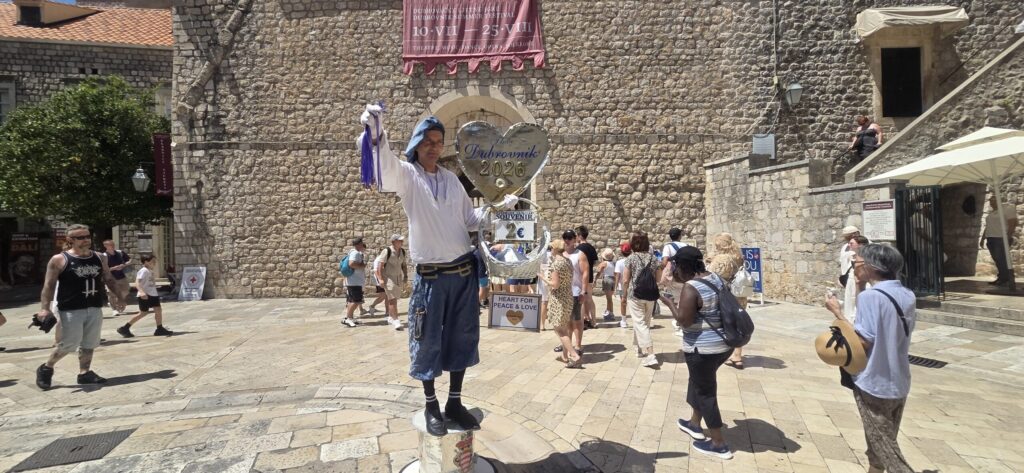
Soon after entering, you will probably notice Mirso, one of the most familiar faces in this part of the city.
He sells the small Dubrovnik Heart, with prices beginning at only a few euros. It is an affordable souvenir, but the person behind it is the main reason I include this stop.
Mirso is hardworking, cheerful and nearly always smiling. Dubrovnik guides know him, residents greet him and many returning visitors remember him.
He has become part of the character of this entrance to the Old Town.
A small souvenir connected with a genuine encounter can sometimes carry a stronger memory than a far more expensive purchase from an anonymous shop.
Stop, say hello and experience the human side of Dubrovnik.
4. Large Onofrio’s Fountain
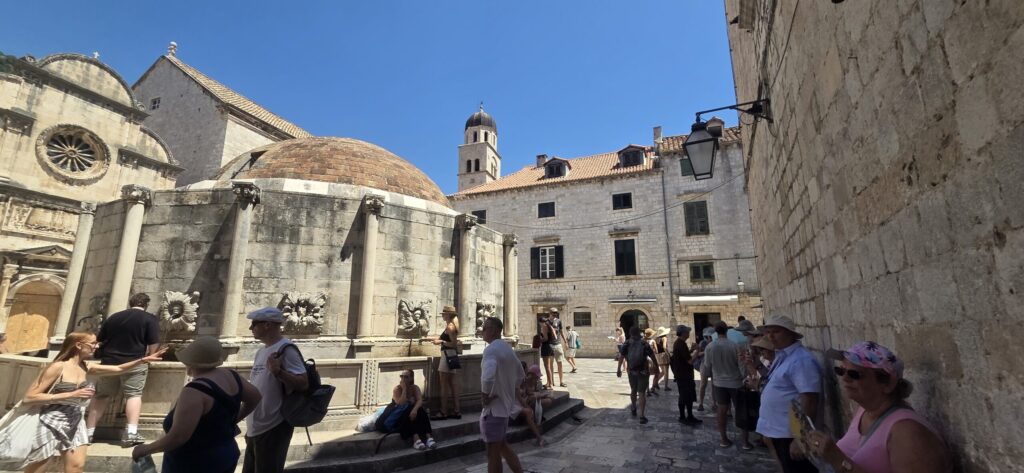
On your right is Large Onofrio’s Fountain, one of the principal landmarks at the western end of Stradun.
The fountain was constructed in the 15th century as part of Dubrovnik’s sophisticated water-supply system. Water was carried into the city from a spring several kilometres away, providing residents with reliable public access to fresh water.
Look around the fountain’s sixteen sides and you will see carved stone masks through which the water flows.
The fountain is still useful today. Visitors and residents regularly refill their bottles here, making it a practical stop before walking the City Walls.
It is also one of Dubrovnik’s most common meeting points, so you will often see guides and small groups gathering around it.
Can You Drink From Onofrio’s Fountain?
The fountain is commonly used for refilling drinking bottles. Respect any temporary maintenance or public-health notice displayed at the site.
During warm weather, bring a reusable bottle and refill it here before continuing.
5. The Main Entrance to the Dubrovnik City Walls
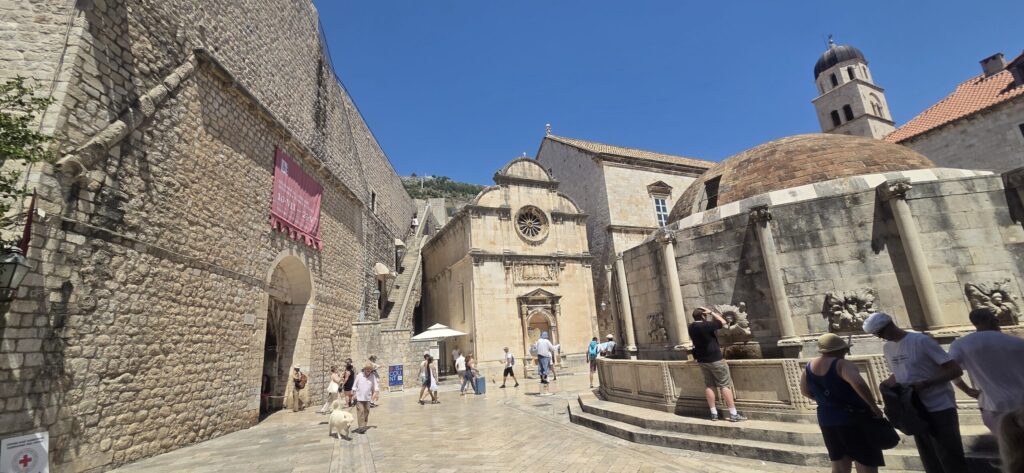
On the left-hand side, close to Large Onofrio’s Fountain, you will find the main Pile entrance to the Dubrovnik City Walls.
There are several entrances to the walls, but this is the most logical starting point for most first-time visitors. It is easy to locate after entering through Pile Gate and begins with one of the most impressive sections of the circuit.
The complete walk requires comfortable shoes, sufficient water and preparation for the weather. During summer, avoid starting in the hottest part of the day. Much of the route is exposed to direct sunlight.
My guide to the Dubrovnik City Walls for first-time visitors explains the entrances, tickets, walking time and summer heat in greater detail. Visitors considering a combined ticket can also read my complete guide to the Dubrovnik Pass.
6. Hard Rock Cafe and the Former Convent of St Clare
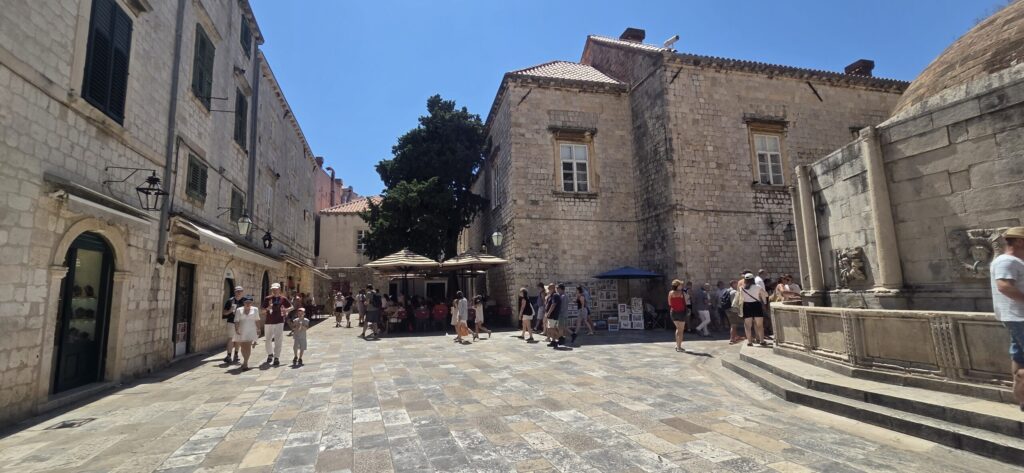
A short detour near the western end of Stradun leads to Hard Rock Cafe Dubrovnik.
The café occupies part of the former Convent of St Clare, a complex historically associated with the education of girls from noble families. An orphanage was also established here in 1432, reflecting the organised approach to social welfare developed by the Republic of Dubrovnik.
Today, the historic setting contains a modern restaurant, music memorabilia and entertainment.
Hard Rock is naturally most relevant to music fans, families and travellers who collect its merchandise. Even for visitors who do not plan to eat there, the history of the former convent makes the location more interesting than its modern name initially suggests.
7. The Dalí Shop and Exhibition
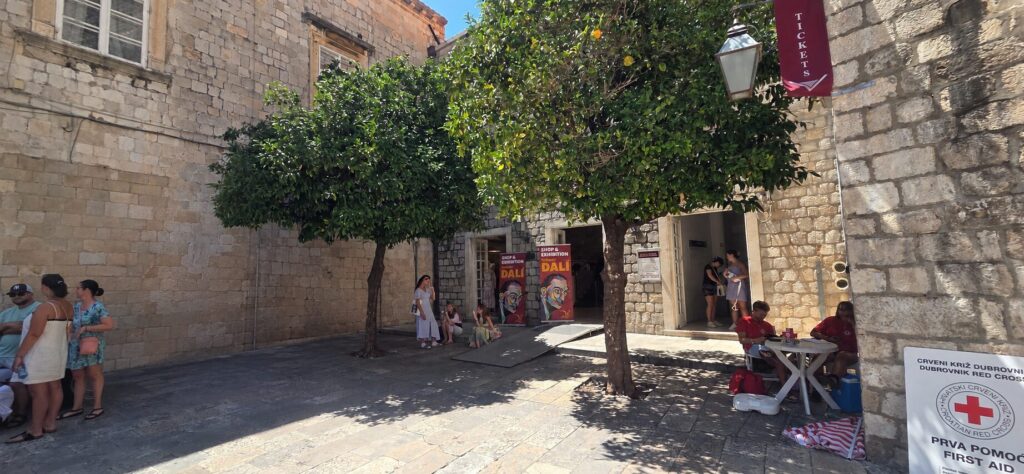
Visitors interested in Salvador Dalí may also notice a Dalí-themed shop and exhibition in this part of the Old Town.
Dalí was a Spanish artist best known for Surrealism and his imaginative, dreamlike imagery. The location may appeal to visitors who already enjoy his work and want to browse prints, books or Dalí-inspired objects.
Treat it as an optional cultural stop rather than an essential Dubrovnik attraction. Read the information about the exhibition carefully before buying admission or making assumptions about the provenance of individual works.
8. The Franciscan Monastery and Historic Pharmacy
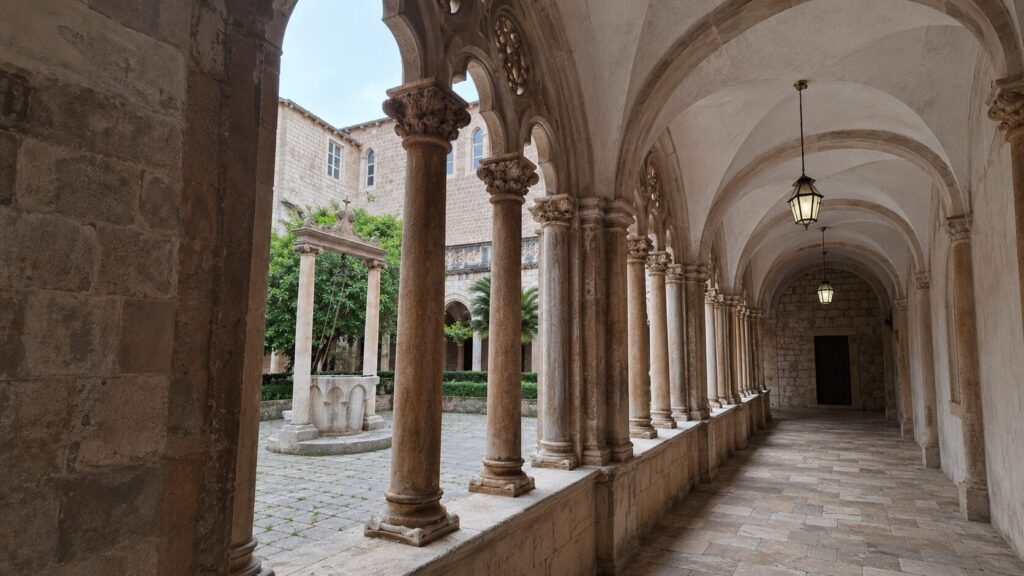
Around twenty metres from the main City Walls entrance, on the same side of Stradun, is the entrance to the Franciscan Church and Monastery.
Many visitors photograph the façade and continue walking. However, the complex contains one of the most peaceful spaces close to busy Stradun.
Inside are a cloister, a museum and a pharmacy whose history dates to 1317. It is widely regarded as one of Europe’s oldest pharmacies still operating.
Is the Franciscan Monastery Worth Entering?
Yes, particularly when you are interested in architecture, medicine or Dubrovnik’s social history.
The cloister provides an immediate contrast with the busy street outside. Allow approximately 20–30 minutes for a relaxed visit.
What If You Do Not Have Time for the Museum?
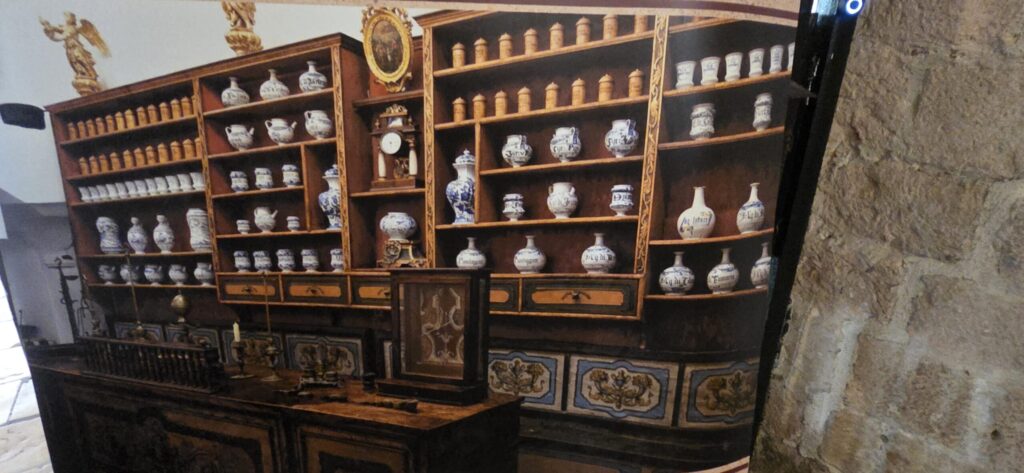
At least enter and see the pharmacy.
Its early establishment gives an immediate sense of how advanced the Republic of Dubrovnik was. The pharmacy formed part of a society that placed considerable importance on healthcare, hygiene, public infrastructure and organised social assistance.
The historical museum collection and the modern working pharmacy are separate elements of the complex. The operating pharmacy sells contemporary pharmaceutical and cosmetic products, while historical instruments, containers and documents form part of the museum interpretation.
Local Tip
When Stradun feels crowded, step inside the Franciscan cloister for ten minutes. It is one of the calmest places in the Old Town, despite being only a few metres from Dubrovnik’s busiest street.
Explore Stradun With a Licensed Local Guide
Walking Stradun takes only a few minutes. Understanding the stories behind its buildings, traditions and people takes a little longer.
My private Dubrovnik walking tours are adapted to your interests, available time and preferred pace. We can focus on history, architecture, everyday city life, photography, family stories or the quieter streets and hidden corners beyond the main route.
9. Why Do the Buildings Along Stradun Look So Similar?
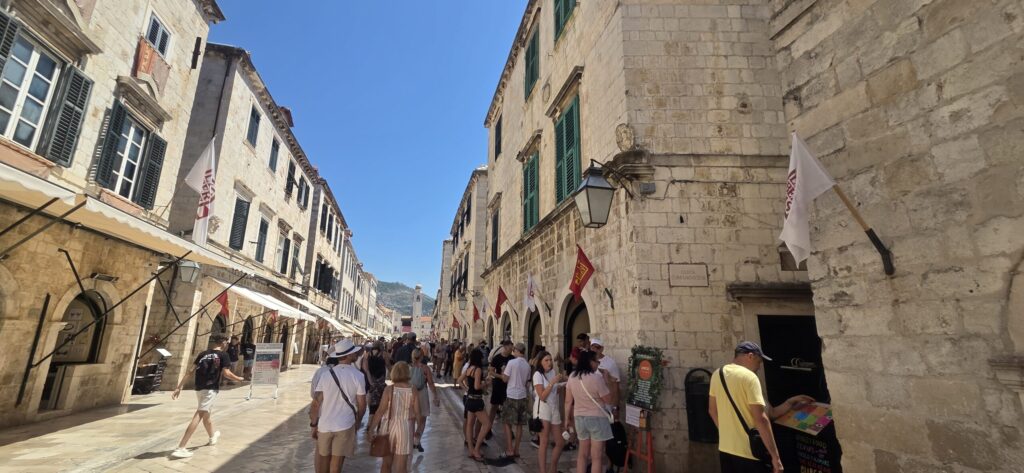
After the Franciscan Monastery, continue east and look at Stradun as a complete urban space rather than a collection of individual buildings.
The street’s unusually uniform appearance is largely the result of rebuilding regulations introduced after the earthquake of 1667. The disaster destroyed or severely damaged much of the city, and the authorities needed to reconstruct its central commercial street quickly, safely and in an orderly way.
New buildings followed a more standardised design. Their height, façades, windows and ground-floor commercial openings were carefully controlled, creating the visual rhythm visitors see today.
Many traditional shopfronts combine a doorway with a stone-framed display opening. The ground floor was used for trade, while living spaces occupied the levels above. This arrangement allowed Stradun to function as both a commercial centre and a residential street.
The pale limestone pavement has been polished by generations of footsteps. It reflects the light beautifully, particularly after rain, but it can also become slippery.
Look north and you will see steep stone streets rising toward the upper residential areas. On the southern side, shorter passages lead toward squares, churches and the sea-facing part of the city.
Visitors interested in exploring beyond the main avenue can continue with my guide to the hidden streets of Dubrovnik, which introduces quieter corners most short visits miss.
10. Gelateria Dubrovnik
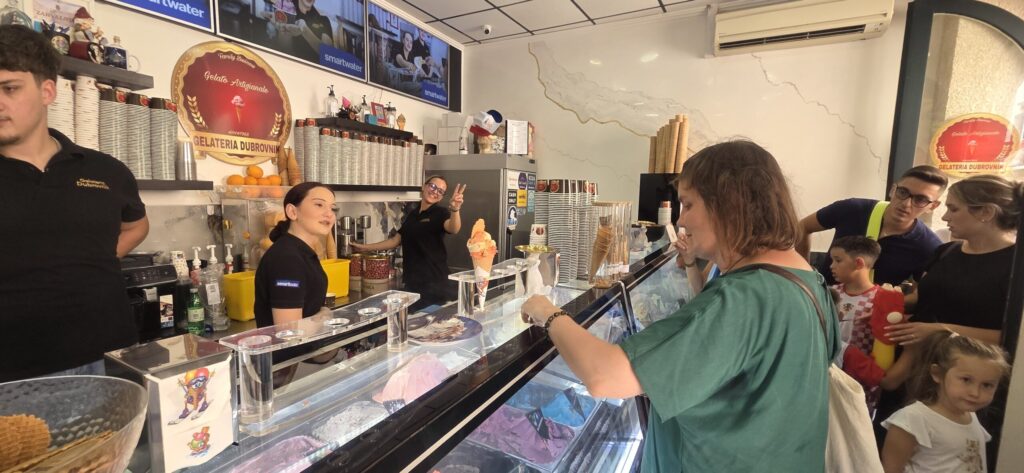
When the weather is warm—or whenever you simply want gelato—Gelateria Dubrovnik is a natural stop.
This family business has been making gelato since 1968 and is now continued by the third generation. Its long tradition and friendly service make it a familiar Dubrovnik institution rather than merely another seasonal ice-cream shop.
Food preferences are personal, so I avoid claiming that one place must be the best for everyone. However, this is one of the gelato shops I recommend most confidently.
Ask which flavours were freshly made or what the family recommends that day. A short gelato break is especially welcome when exploring Stradun with children.
11. Souvenirs and Croatian Football Shirts
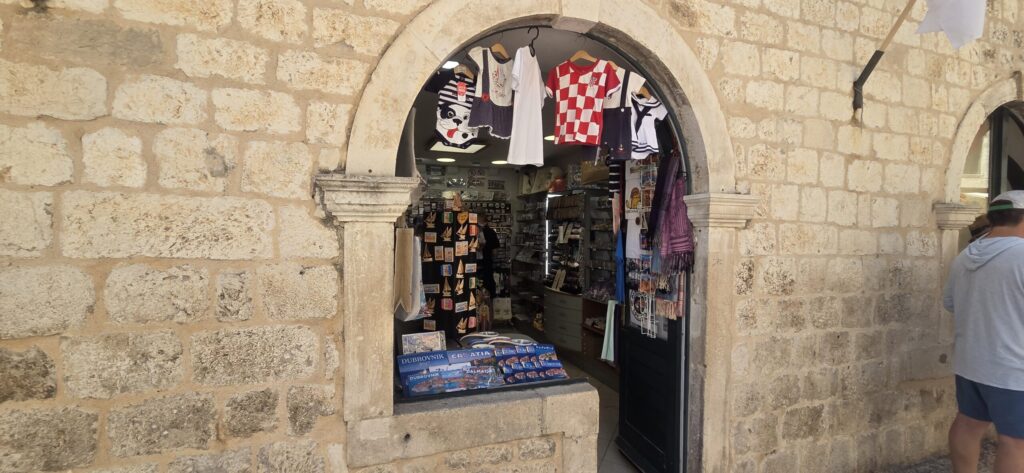
As you continue, you will pass numerous souvenir shops.
Some sell locally designed or handmade items. Others offer standard magnets, mugs, postcards and inexpensive gifts. There are options for almost every budget, and an affordable souvenir is not automatically a bad purchase.
You will also see many shirts connected with the Croatian national football team. Croatia’s international football success is a source of enormous national pride, so these shirts reflect something real about contemporary Croatian identity.
When something is presented as locally made, ask:
- Who created it?
- Where was it produced?
- Does the design have a particular connection with Dubrovnik?
- Is it handmade, locally designed or imported?
The aim is not to avoid inexpensive souvenirs but to understand what you are purchasing.
12. Café Festival
On the left side of Stradun, Café Festival occupies a prominent position near the Franciscan Monastery.
Its tradition dates to 1927, and it continues to operate as a café, restaurant and evening meeting place. The terrace is well positioned for watching the movement of Stradun.
Prices naturally reflect the central location. You are paying not only for a coffee or meal but also for the atmosphere of sitting on Dubrovnik’s principal street.
Festival is a suitable choice when the setting and people-watching matter more than finding the least expensive coffee. It can be particularly pleasant later in the day when the temperature falls and the street becomes more relaxed.
My article about Croatian coffee culture in Dubrovnik explains why coffee here is normally treated as a social ritual rather than something to drink quickly.
13. Keep the Bell Tower in Sight
Throughout the walk, the Dubrovnik Bell Tower remains visible ahead of you.
It provides a useful visual guide toward Luža Square and creates one of Stradun’s most recognisable perspectives.
The tower rises approximately 31 metres beside the former City Guard building. Its original form dates from the 15th century, although it was reconstructed in the early 20th century after structural problems.
The bell is struck by two bronze figures known locally as zelenci, meaning “the green men,” after the green patina that developed on their surfaces. The figures visible today are replicas, while the historic originals are preserved.
Public timekeeping had an important role in a disciplined commercial republic. The bell helped organise government, trade, religious observance and daily life.
14. Cele
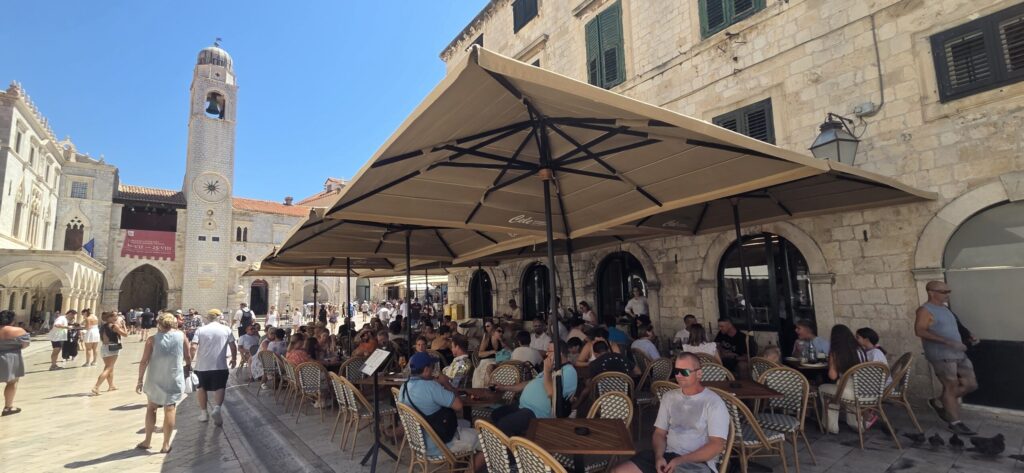
As you approach Luža Square, Cele is located on the right-hand side.
It is a contemporary café, restaurant and lounge with a broad menu and one of the most central terraces in the Old Town.
Its main advantage is the location. From here, you are close to the Bell Tower, Orlando’s Column and the Church of St Blaise.
Cele can be convenient for mixed groups in which some people want coffee, others want food and someone else simply wants to rest and watch the street.
15. La Bodega
A little farther along is La Bodega, another lively contemporary venue near the eastern end of Stradun.
It offers casual food, drinks and cocktails, with an atmosphere that usually becomes more energetic later in the day.
Choose it for its central position and lively setting rather than as a historic Dubrovnik experience. Whether it suits you depends on the type of break you prefer.
16. The Church of St Blaise
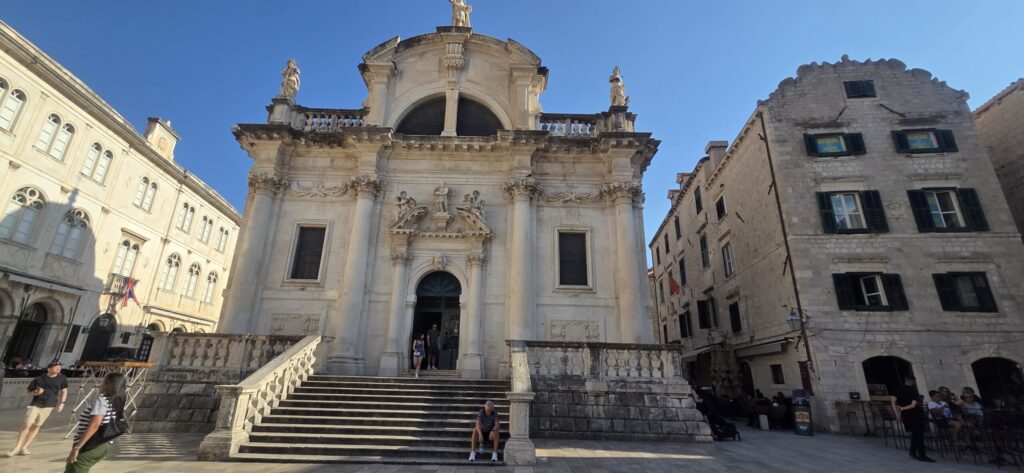
On the right-hand side of Luža Square stands the Church of St Blaise, dedicated to Dubrovnik’s patron saint.
The present Baroque church was completed in the early 18th century after the earlier church was damaged by the earthquake of 1667 and later destroyed by fire.
Inside is a silver-gilt statue of St Blaise holding a model of Dubrovnik. The model is historically important because it preserves an image of the city before the earthquake altered much of its architecture.
St Blaise remains central to Dubrovnik’s identity. His image appears above gates and on public buildings, while the city celebrates his feast on 3 February with religious ceremonies and a procession along Stradun.
Even when you are not religious, step inside respectfully. The church helps explain the close historical relationship between Dubrovnik’s civic and spiritual identity.
17. Orlando’s Column
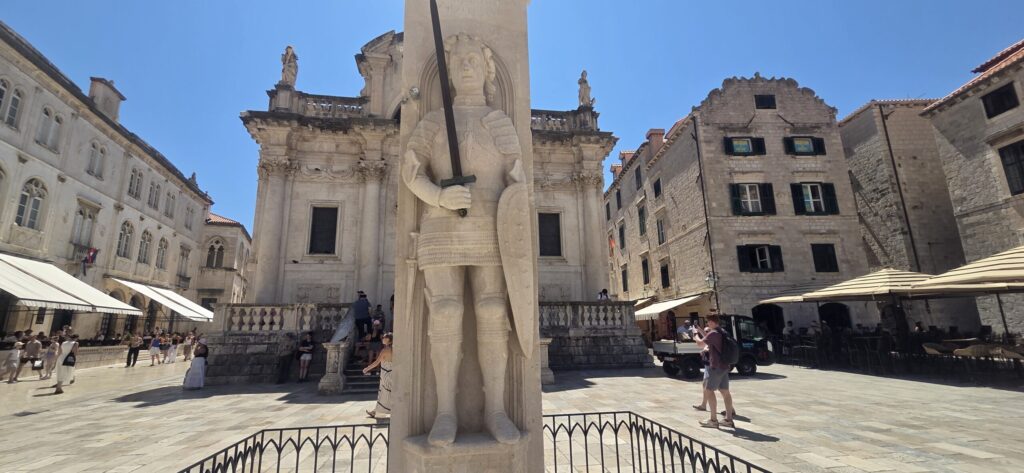
A short distance in front of the Church of St Blaise stands Orlando’s Column.
The Gothic stone figure represents a medieval knight holding a sword. It was erected in the early 15th century and became a symbol of Dubrovnik’s civic freedom and independence.
Orlando was not a historical resident of Dubrovnik. Similar Roland figures appeared in European cities as symbols of legal authority and autonomy.
The column also had practical functions. The length of Orlando’s forearm was associated with the Dubrovnik cubit, a standard unit used in trade. Public announcements were made nearby, and the area formed part of the political and ceremonial centre of the Republic.
Today, the Libertas flag is raised near Orlando during the Dubrovnik Summer Festival.
18. Sponza Palace: The Wall Street of Old Dubrovnik
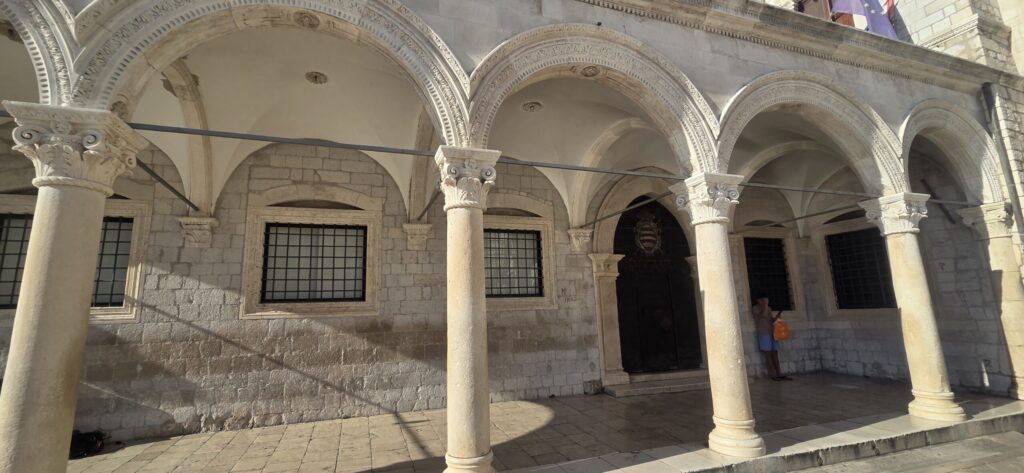
On the left side of Luža Square stands Sponza Palace, one of the city’s finest surviving historic buildings.
Constructed in the early 16th century, it combines Gothic and Renaissance elements and survived the earthquake of 1667 largely intact.
Sponza was connected with customs, trade, finance, weights and measures, and the regulation of goods entering the Republic. I sometimes describe it to guests as the Wall Street of old Dubrovnik.
Dubrovnik’s success depended heavily on commercial trust. The Republic did not control a vast territory or possess a large army. Its strength came from maritime trade, diplomacy, information, reputation and disciplined institutions.
Visitors interested in this subject may also enjoy why the Republic of Dubrovnik was one of history’s greatest business success stories and my article about Dubrovnik Old Port maritime history.
The Memorial Room of the Dubrovnik Defenders
Visitors interested in the Croatian War of Independence and the siege of Dubrovnik should enter Sponza Palace.
Immediately to the left is the Memorial Room dedicated to the Dubrovnik defenders who lost their lives protecting the city. Photographs, names and documentary material present the wartime experience of Dubrovnik and its residents.
Entrance to the memorial room is free.
It is a small but emotionally important place. Enter quietly and respectfully.
19. Small Onofrio’s Fountain
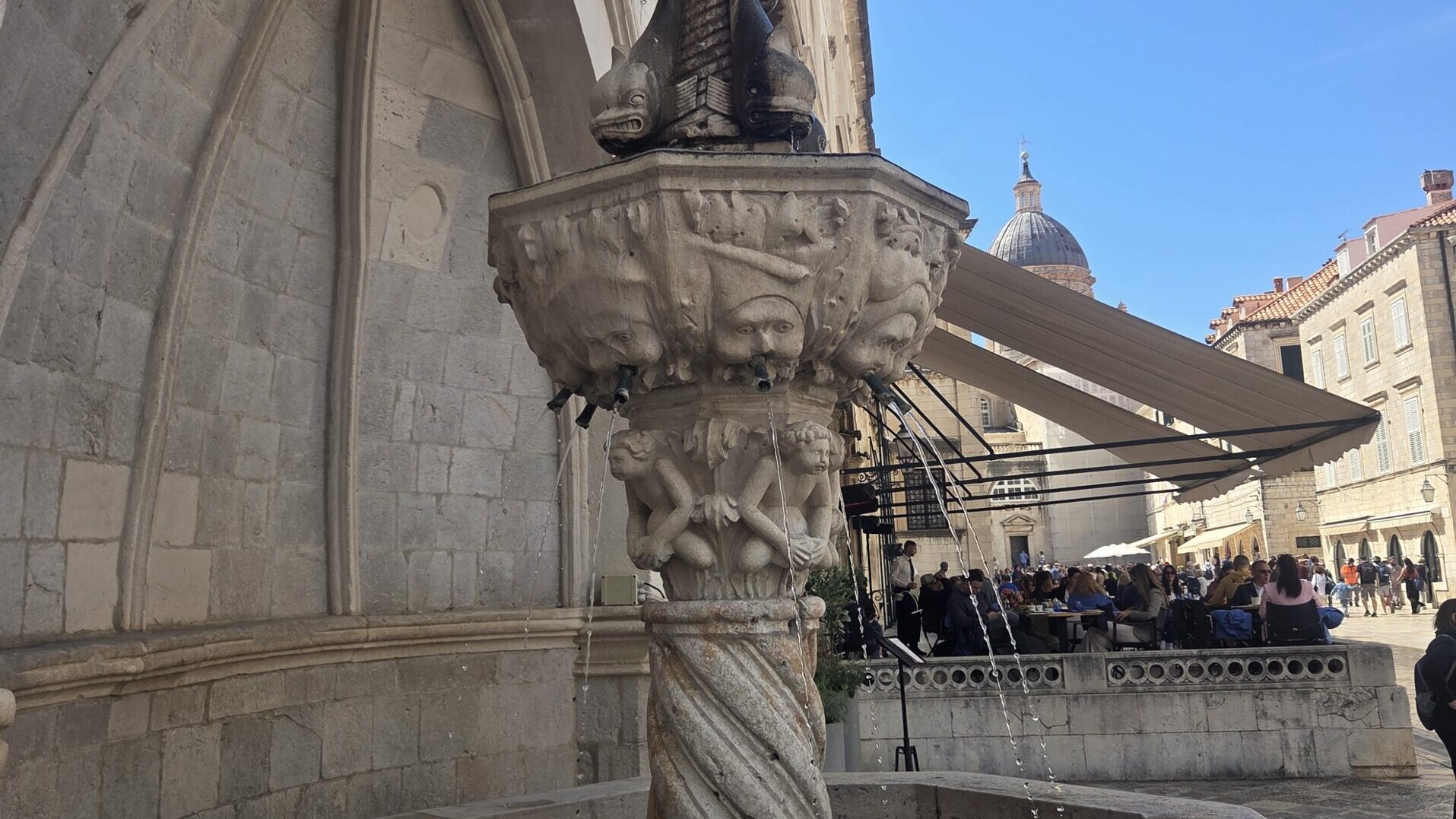
Immediately below the Bell Tower area is Small Onofrio’s Fountain.
Like the larger fountain near Pile Gate, it formed part of Dubrovnik’s 15th-century water-supply system. It was completed in 1446 and positioned beside the City Guard building.
The smaller fountain is more decorative and compact. Together, the two fountains create natural markers at opposite ends of Stradun.
Many visitors overlook it because their attention is fixed on the Bell Tower, Orlando’s Column or the Church of St Blaise. Take a moment to notice how water, commerce, government, religion and public timekeeping were concentrated within this small part of the city.
Best Photo Spots on Stradun
Stradun changes significantly with the light, crowds and weather. These are the places I find most useful for photographs.
Pile Gate Entrance
Photograph the sequence of gates and stone passages before entering. Early morning is best if you want fewer people in the frame.
Large Onofrio’s Fountain
Stand slightly away from the fountain to include both its stone structure and the beginning of Stradun behind it.
The Middle of Stradun
From the central part of the street, photograph toward the Bell Tower. This is the classic view that shows the uniform façades and long perspective of the main street.
Stradun After Rain
The polished limestone reflects façades, lights and passing figures beautifully after rainfall. Take care because the pavement can become slippery.
The Bell Tower and Luža Square
The eastern end of Stradun offers several strong compositions combining the Bell Tower, Orlando’s Column, the Church of St Blaise and Sponza Palace.
Local Photography Tip
The quietest photographs are usually possible early in the morning. For warmer light and more atmosphere, return in the late afternoon or around blue hour.
How Long Should You Spend on Stradun?
| Time available | Suggested route |
|---|---|
| 30 minutes | Pile Gate, Large Onofrio’s Fountain, Franciscan exterior, Stradun, Bell Tower, Orlando’s Column, St Blaise and Sponza |
| 60 minutes | Add Ankica, Mirso, the Franciscan Pharmacy, architectural details and Small Onofrio’s Fountain |
| 90 minutes | Add the monastery interior, gelato, Memorial Room and time for photographs |
| Two hours | Add a relaxed coffee or food stop, side streets and the Old Port |
| Three hours | Combine Stradun with a broader guided Old Town walk or the City Walls |
When Is the Best Season to Walk Along Stradun?
Stradun is open and active throughout the year, but the experience changes considerably by season.
Spring
Spring usually offers comfortable walking temperatures and fewer crowds than the main summer months. Café terraces begin to feel lively, but the street is generally easier to explore at a relaxed pace.
Summer
Summer brings the busiest atmosphere, the largest number of cruise visitors and the strongest heat. Start early or visit later in the afternoon. Midday can be crowded, and the limestone reflects considerable heat.
Autumn
Early autumn can be particularly pleasant, with warm weather and slightly fewer visitors. As the days become shorter, late-afternoon light reaches Luža Square earlier.
Winter
Winter reveals a quieter and more residential side of Stradun. Some businesses reduce their opening hours, but Dubrovnik residents reclaim more of the street, particularly during Advent and the celebrations surrounding the Feast of St Blaise.
For a more detailed comparison, read my guides to the best time to visit Dubrovnik Old Town during the day and the best time to visit Dubrovnik month by month.
Is This Route Suitable for Senior Travellers?
Yes. Stradun is wide, central and almost completely level, making it one of the easiest walking areas in Dubrovnik.
However, the polished stone can become slippery in rain, and large crowds may make movement uncomfortable during peak hours. Individual attractions such as the City Walls contain many stairs and are not appropriate for every visitor.
My guide to Dubrovnik for senior travellers provides a comfortable route through the historic centre that avoids unnecessary climbing.
Is This Guide Useful for Cruise Guests?
Yes. Stradun provides a clear and efficient introduction to Dubrovnik for cruise guests who may have only a few hours in the city.
Passengers arriving in Gruž normally travel by taxi, shuttle or private transfer to Pile Gate. From there, this route leads directly through the main part of the Old Town.
Allow sufficient time to return to the ship. Traffic between Pile and Gruž can become slow when several vessels are in port.
My Dubrovnik Cruise Port Guide explains how to organise a short visit. How a private Dubrovnik shore excursion actually works provides more detail about pickup, timing, panoramic stops and returning to the vessel.
Guests who would like transport, panoramic viewpoints and a personalised Old Town experience can also explore my private Panoramic and Old Town excursions, which are planned around the ship’s arrival and departure schedule.
Frequently Asked Questions About Stradun
Is Stradun Worth Visiting?
Yes. Stradun is the central street of Dubrovnik Old Town and connects many of the city’s most important monuments, including Large Onofrio’s Fountain, the Franciscan Monastery, the Bell Tower, Orlando’s Column, the Church of St Blaise and Sponza Palace.
It is worth visiting for more than its architecture. Artisans, familiar Dubrovnik personalities, family businesses, cafés and daily city life make Stradun feel like a living street rather than only a historic attraction.
Even visitors with limited time should walk its full length from Pile Gate to Luža Square.
Is Stradun Free to Visit?
Yes. Stradun is a public pedestrian street. Individual attractions such as the City Walls and some museums require tickets.
Is Stradun the Same as Placa?
Yes. Placa is the street’s official and historical name, while Stradun is the name more commonly recognised by international visitors.
How Long Is Stradun?
Stradun is 298 metres long, extending from the western entrance near Pile Gate to Luža Square in the east.
How Long Does It Take to Walk Stradun?
You can walk its full length in approximately ten minutes without stopping. Allow 60–90 minutes to see the main monuments, visit the Franciscan complex and stop at selected independent businesses.
What Is the Best Time to Visit Stradun?
Early morning is best for quieter photographs and comfortable walking. Late afternoon and evening offer more atmosphere. Midday can be hot and crowded during summer.
My guide to the best time to visit Dubrovnik Old Town compares morning, afternoon and evening in greater detail.
Can You Drink From Onofrio’s Fountain?
Visitors and residents commonly refill bottles at Large Onofrio’s Fountain. Follow any temporary maintenance or public-health information displayed at the site.
Where Is the Main City Walls Entrance?
The main Pile entrance is on the left-hand side near Large Onofrio’s Fountain, shortly after entering through Pile Gate.
Is the Franciscan Pharmacy Still Open?
Yes. A modern operating pharmacy remains within the Franciscan complex. The site’s pharmacy tradition dates to 1317, while historical instruments and records are presented separately as part of the museum collection.
Where Can I Find Handmade Dubrovnik Souvenirs?
Begin with Ankica near Pile Gate and Mirso’s Dubrovnik Heart. Elsewhere, ask where a product was made and what connection it has with Dubrovnik or the surrounding region.
Is Stradun Accessible by Wheelchair?
The main street is broad, smooth and almost completely level. However, the stone can be slippery, crowds can create difficulties and several individual attractions have steps.
Are Restaurants on Stradun Expensive?
Prices generally reflect the street’s central and highly visible location. Visitors are paying partly for the setting and atmosphere. Compare displayed menus before choosing.
Stradun Ends, but the Old Town Continues
By the time you reach Luža Square, you have crossed the full length of Stradun, but you have explored only one central line of Dubrovnik.
From here, you can continue toward the Old Port, Rector’s Palace, the Cathedral, Gundulić Square, the Dominican Monastery or the quieter streets leading toward Ploče Gate.
For later in the day, my guide to the best sunset spots in Dubrovnik includes four viewpoints I genuinely recommend rather than a generic list of every possible location.
Cruise guests who would like to combine Stradun with panoramic viewpoints, private transport and a carefully timed return to their ship can also explore my custom private Dubrovnik shore tours.
Walk Stradun Independently—or Discover the Stories Behind It
This guide is designed to help you walk Stradun independently and understand the main landmarks, independent businesses and practical details along Dubrovnik’s central street.
The route is easy to follow, but Stradun is only the beginning. Behind its uniform façades are legends, family stories, political decisions, commercial traditions and wartime memories that are easy to miss without deeper context.
Through my private Dubrovnik walking tours, the route can be adapted to your interests and preferred pace. We can focus on history, architecture, everyday city life, photography or the quieter streets beyond Stradun.
After thousands of walks along this street, I still slow down as I approach the Bell Tower. The limestone changes colour as the afternoon light reaches Luža Square, café terraces begin to fill and church bells echo through the historic centre.
For a few moments, Dubrovnik feels less like one of Europe’s most famous destinations and more like the city its residents have known for generations.
I hope this guide helps you experience Stradun in the same way.
About the Author
Ajla Hadžić is a licensed Dubrovnik guide with more than ten years of professional guiding experience and the founder of VipWalk Dubrovnik.
She specialises in private Dubrovnik walking tours, personalised experiences in the historic centre and private shore excursions for couples, families, senior travellers and cruise guests. Her guides combine historical interpretation with practical advice and firsthand experience gathered from guiding visitors through Dubrovnik throughout the year.