Beyond the Ordinary: Step inside Dubrovnik’s former seat of government to discover the Republic of Ragusa’s political traditions, remarkable architecture, and fascinating museum treasures.
Rector’s Palace Dubrovnik is one of the city’s most important historic landmarks, but its greatest stories are hidden beyond its elegant Gothic-Renaissance façade. Once the official residence of the rector and a center of government in the Republic of Ragusa, the palace now houses the Cultural History Museum, where historic interiors, paintings, ceremonial objects, and centuries-old treasures reveal Dubrovnik’s extraordinary past.
During our VipWalk visit in August 2026, we explored the sunlit atrium, the rector’s apartment, richly furnished reception rooms, and fascinating objects that bring the former Republic to life.
As a licensed local guide, I have passed this building countless times. Yet stepping inside offers a perspective that even frequent visitors to Dubrovnik may never experience.
Here, the history of the city becomes wonderfully tangible, from the rector’s unusual one-month mandate to the magnificent sedan chairs, the original Zelenci bronze figures, and the political ideals expressed in a few words carved into stone.
The palace does not simply tell the story of one ruler. It tells the story of an entire republic.
Rector’s Palace at a Glance
- Location: Pred Dvorom 3, Dubrovnik Old Town, Croatia.
- Museum: Cultural History Museum, part of Dubrovnik Museums.
- Summer opening hours: April 1–October 31, 9 AM–6 PM daily.
- Winter opening hours: November 1–March 31, 9 AM–4 PM, closed Mondays.
- Individual admission: Adults €15; schoolchildren and students €8.
- Dubrovnik Pass: Includes admission to the museum.
- Suggested visiting time: 45–60 minutes, or longer for history enthusiasts.
- Highlights: The atrium, Miho Pracat’s bust, rector’s apartment, historic sedan chairs, original Zelenci figures, paintings, coins, and official seals.
A Palace Without a King: The Republic of Ragusa’s Political System
Imagine a prosperous Mediterranean city with magnificent stone buildings, wealthy merchant families, and international commercial connections — but no king.
For centuries, Dubrovnik was governed as an aristocratic republic rather than a hereditary monarchy.
Its institutions included the Great Council, Senate, Minor Council, and rector, who served as the state’s highest representative.
The most surprising detail for many visitors is the rector’s extraordinarily short mandate.
He was elected for just one month.
This arrangement helped prevent excessive concentration of authority in one person and reflected the Republic’s concern with institutional continuity.
The position also carried unusual restrictions.
The rector was required to reside in the palace during his mandate. His movements were carefully regulated, and leaving the building was generally restricted to prescribed official purposes.
Historical accounts also describe ceremonial responsibilities associated with the city gates and their keys, reflecting the importance attached to the office.
Imagine occupying the Republic’s most prestigious position while living under such carefully controlled conditions.
The rector represented the state, but the political institutions were intended to remain more powerful than the individual holding office.
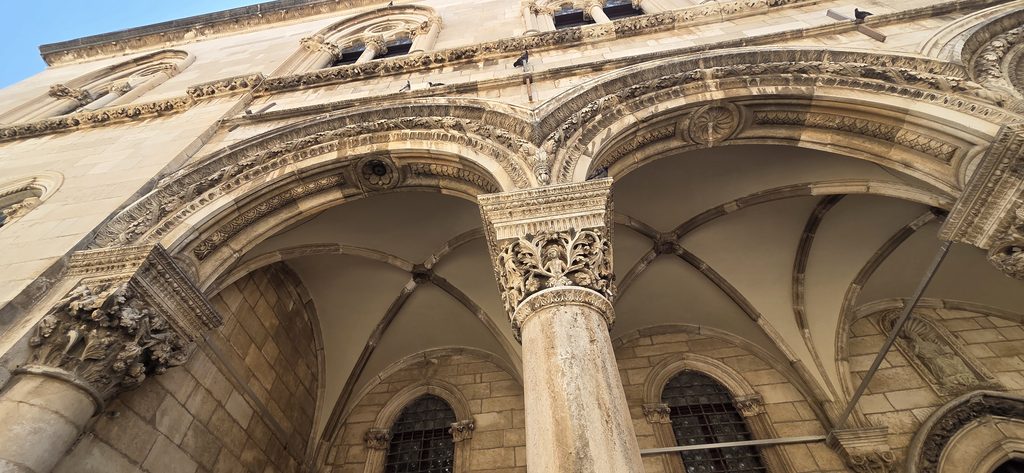
Was Dubrovnik Really a Democracy?
Not in the modern sense.
Political authority was largely reserved for hereditary noble families. Ordinary citizens, women, and much of the population were excluded from the Republic’s highest governing bodies.
The celebrated ideal of liberty referred primarily to Dubrovnik’s political independence and the preservation of its established institutions.
Its history also includes aristocratic privilege, social inequality, and slavery.
Acknowledging these realities helps us understand the Republic without romanticizing its past.
Dubrovnik developed an unusual and sophisticated political system, but it remained a society shaped by the limitations of its historical period.
The Famous Latin Inscription: Public Duty Before Private Interests
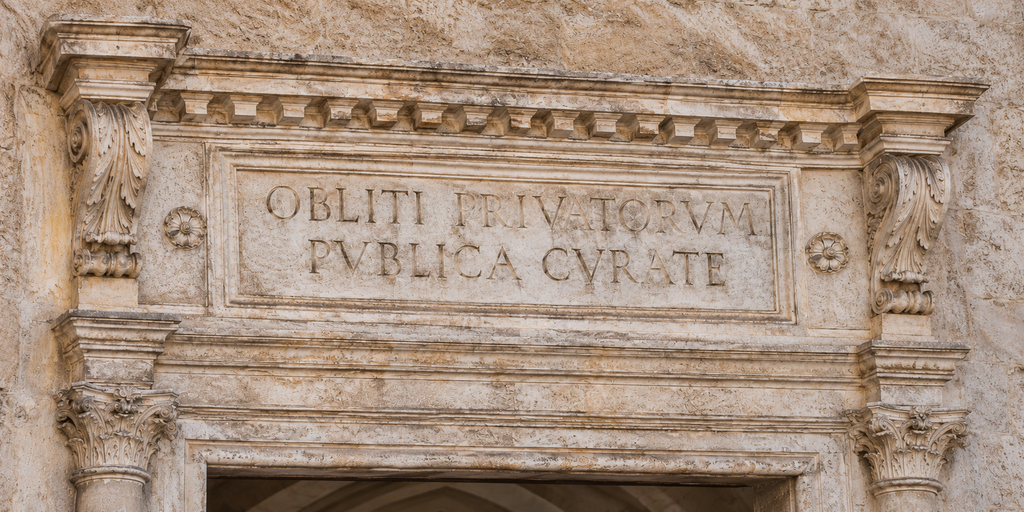
One of the most revealing details associated with the palace is the Latin inscription:
OBLITI PRIVATORUM PUBLICA CURATE
“Put private interests aside and care for public affairs.”
The inscription stands above the historic doorway that connected the Rector’s Palace with the neighboring Great Council Palace.
The Great Council had its own building, although the two government complexes were connected internally.
These words reminded Dubrovnik’s ruling elite that public responsibilities should take precedence over personal ambition and family interests.
Political life was naturally more complicated. Noble families exercised influence, and commercial connections played an important role in public affairs.
Nevertheless, the inscription expresses one of the Republic’s most enduring political ideals.
A local guide’s observation: The words become particularly meaningful when you consider their setting. They were placed in a government complex, where officials were expected to make decisions affecting the entire Republic.
It is a small architectural detail with an unusually powerful message.
Gothic, Renaissance, and Baroque: A Palace Shaped by Centuries of Change
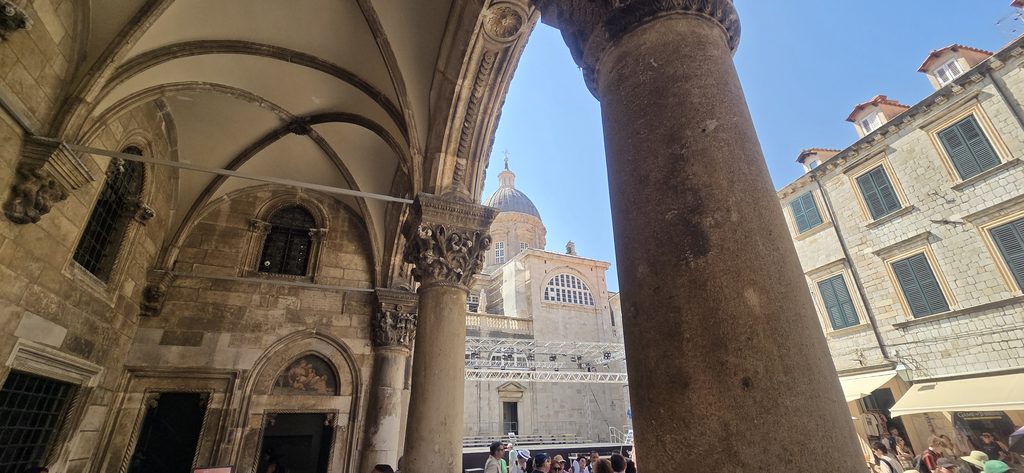
The architectural history of the palace is a remarkable story of destruction, rebuilding, and continuity.
Its origins lie in a medieval defensive and administrative complex, but much of its recognizable appearance developed during the 15th century.
The principal Gothic-Renaissance design is associated with Onofrio di Giordano della Cava, the Neapolitan architect also connected with Dubrovnik’s historic water-supply system.
The Gunpowder Explosions of 1435 and 1463
A devastating explosion in 1435 severely damaged the earlier building.
The reconstruction that followed established important elements of its architectural identity.
Another explosion in 1463 required further repairs and alterations, gradually introducing additional Renaissance features.
Different architects and craftsmen contributed to these successive phases. The palace should therefore be understood as the result of several generations of work rather than the creation of a single designer.
The Great Earthquake of 1667
Dubrovnik’s catastrophic earthquake also damaged the palace.
Later restoration introduced Baroque elements, particularly within the interiors.
Today, the building combines Gothic, Renaissance, and Baroque influences in an unusually harmonious composition.
What to Notice Before Entering
Take a moment to examine the finely carved capitals supporting the exterior portico.
Their sculptural details reward a closer look.
The graceful arches, carefully balanced proportions, and stone decoration reflect the craftsmanship of the artists and builders who contributed to the palace.
Inside, the courtyard offers an entirely different architectural experience.
Inside the Atrium: The Architectural Heart of Rector’s Palace
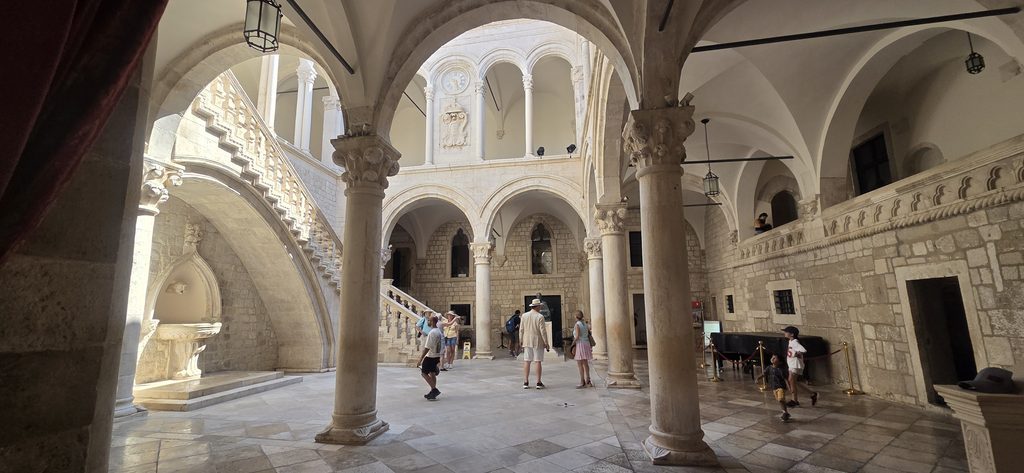
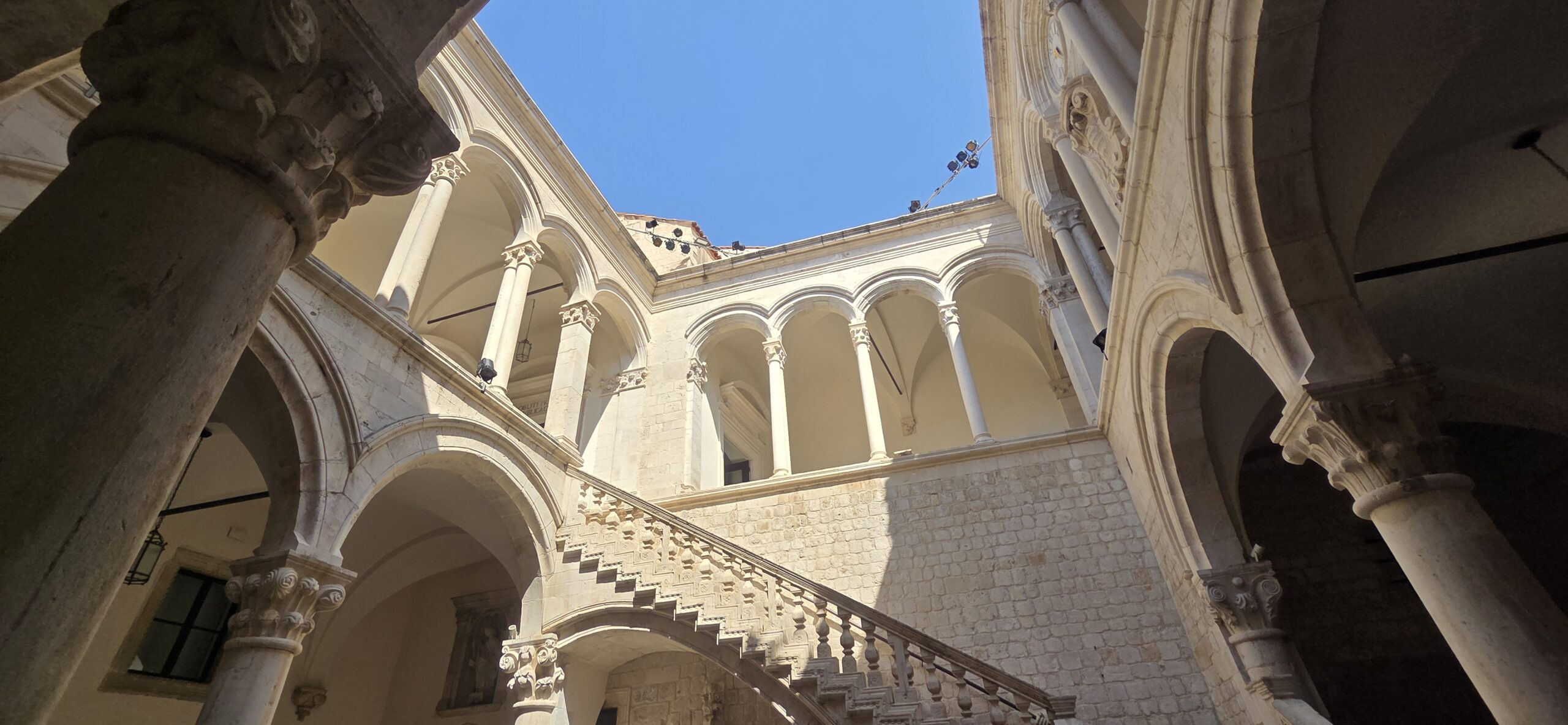
Stepping into the atrium is one of the highlights of the visit.
The lively streets outside give way to a courtyard framed by elegant stone arcades.
Natural light enters from above, illuminating the columns, carved capitals, and impressive staircase.
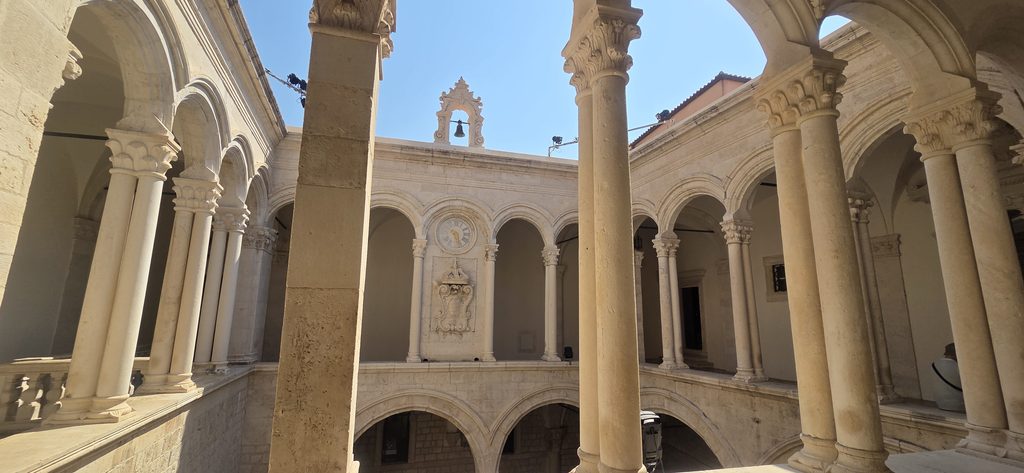
From the upper gallery, visitors can admire the proportions of the courtyard from a different perspective.
During our August visit, we photographed the courtyard from several viewpoints, including the upper arcade, where the arrangement of arches and columns is especially striking.
My local tip: Take time to look both upward and downward. The architectural proportions and sculptural details change depending on where you stand, while the natural light brings out different textures in the stone.
Today, the atrium is also associated with classical music performances during the Dubrovnik Summer Festival.
But one of its most memorable features is a monument to an exceptional local man.
Miho Pracat: An Extraordinary Honor in an Aristocratic Republic
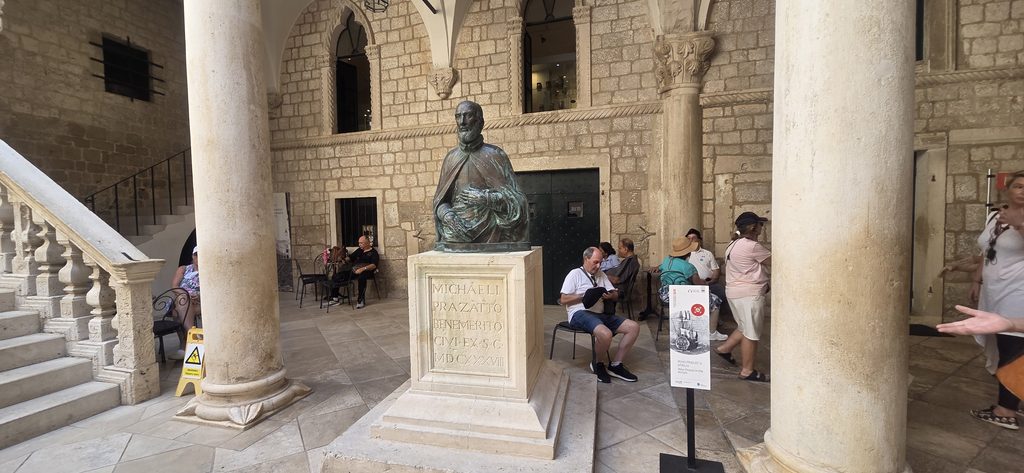
The courtyard contains a bust of Miho Pracat, a wealthy merchant, sea captain, and benefactor from the island of Lopud.
Pracat accumulated considerable wealth through maritime commerce and became known for his charitable generosity.
He is remembered as the only commoner to whom the Republic of Ragusa erected a public monument during its existence.
This was an exceptional distinction in a society that generally discouraged the public glorification of individuals.
The Legend of Miho Pracat and the Lizard
One of Dubrovnik’s best-known local legends associated with Pracat involves a lizard.
According to the story, he watched the animal repeatedly attempting to climb a wall.
Each time it fell, it tried again.
Inspired by its persistence, Pracat supposedly decided not to abandon his ambitions.
The story is folklore rather than documented biography, but it remains a charming part of Dubrovnik’s storytelling tradition.
Pracat’s life also connects naturally with the Republic’s maritime heritage. Our article about Dubrovnik’s Old Port and its maritime history explores the world of ships, merchants, and sea captains that helped shape the city.
Inside the Cultural History Museum: What We Discovered
The Cultural History Museum occupies the former government residence and preserves extensive collections reflecting Dubrovnik’s political, artistic, commercial, and social history.
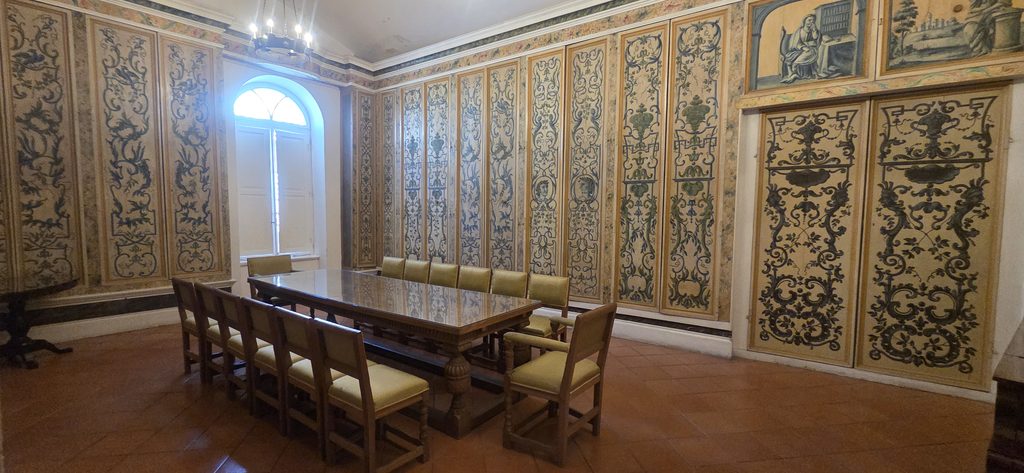
Its permanent displays include state offices, the courtroom, former prison, chapel, reception rooms, and rector’s apartment, alongside paintings, furniture, coins, seals, weapons, and decorative objects.
The museum’s wider holdings contain approximately 20,000 objects, although only a selection is displayed at any given time.
What makes the experience special is the relationship between the exhibits and the building itself.
Visitors are exploring rooms that formed part of the historic government complex, not simply viewing objects in a modern gallery.
The Rector’s Bedroom: Prestige and Restriction
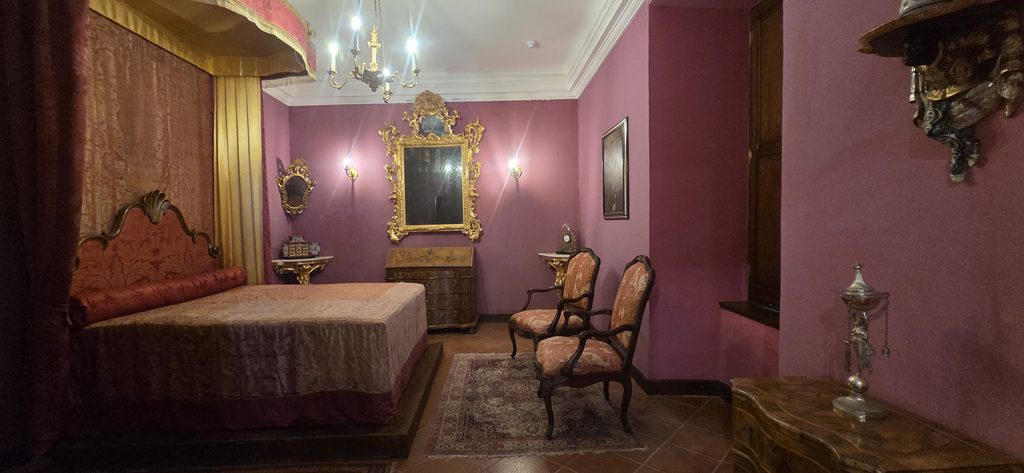
One of the most atmospheric interiors we photographed was the rector’s bedroom.
Deep red walls, an elaborate canopied bed, gilded mirrors, upholstered chairs, and period furnishings create an impression of elegance and status.
Yet the room becomes more meaningful when connected with the rector’s political role.
Despite holding the Republic’s highest representative office, he lived under strict rules during his month in residence.
The bedroom evokes private comfort within a building devoted to public responsibility.
That contrast is more revealing than its decoration alone.
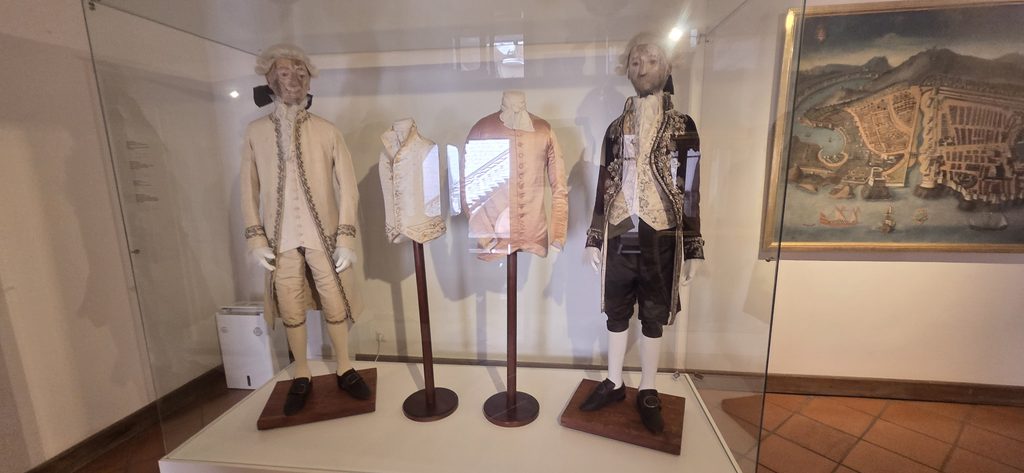
The finely embroidered coats, elegant waistcoats, and powdered wigs displayed in the museum offer a fascinating glimpse into the fashion of Dubrovnik’s aristocracy, when clothing was not merely a matter of personal taste but also a visible expression of wealth, status, and social distinction.
The Reception Rooms: Dubrovnik’s Aristocratic World
The formal reception rooms present another side of the palace.
High ceilings, chandeliers, historic portraits, ornate mirrors, and beautifully crafted furniture reflect the artistic tastes of Dubrovnik’s elite.
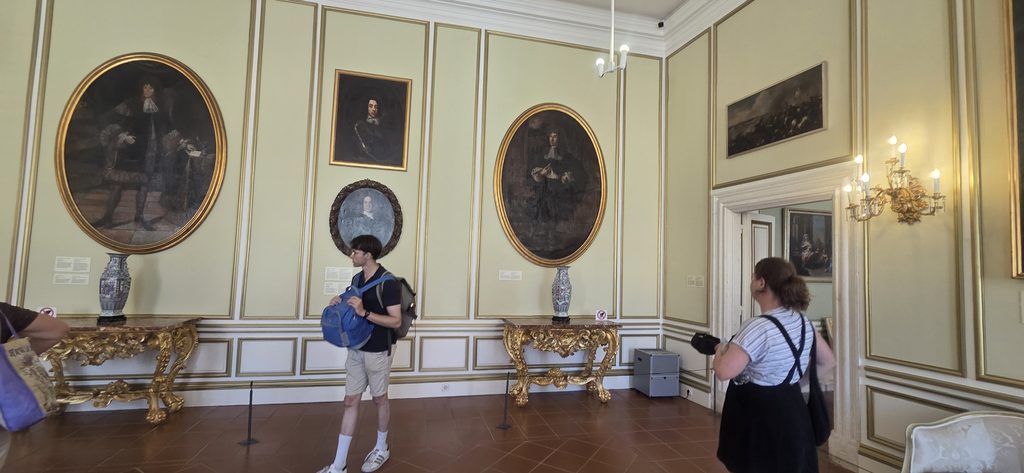
Our photographs show elegant consoles, upholstered chairs, decorative objects, and carefully arranged interiors.
These furnishings demonstrate the wider European artistic influences that reached Dubrovnik through its commercial and cultural connections.
Look closely at the portraits: Clothing, posture, accessories, and artistic presentation offer clues about social position, fashion, and cultural identity.
They give the Republic’s history a more human dimension.
Historic Sedan Chairs: Luxury and Everyday Life
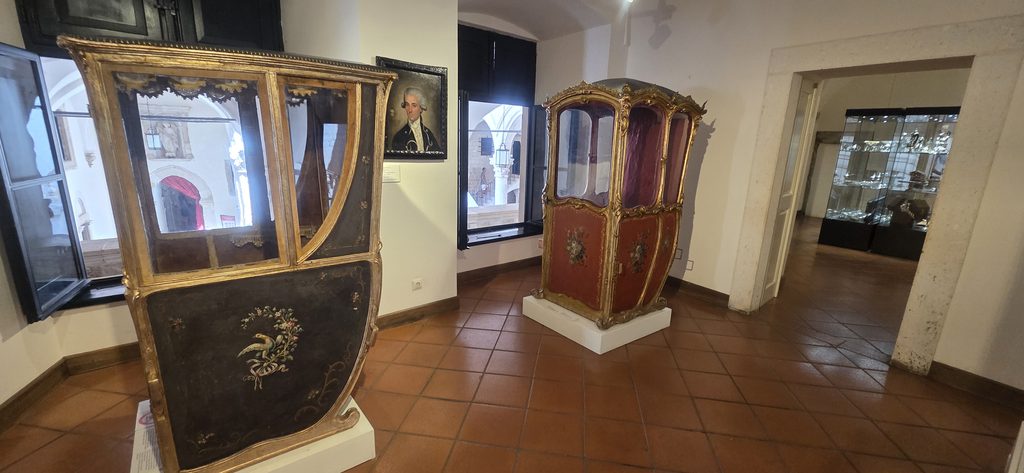
Among the most unusual objects we encountered were two richly decorated sedan chairs.
These enclosed passenger chairs were carried by attendants and used by people of wealth or high social standing.
One features dark painted panels, delicate floral decoration, and gilded framing.
The other has rich red upholstery, elaborate gold ornamentation, and curved windows.
Their practical purpose was transportation, but their appearance also communicated prestige.
In Dubrovnik’s narrow stone streets, carrying chairs belonged to a world very different from modern urban transport.
For visitors, they offer a vivid connection with the customs and social distinctions of earlier centuries.
The Courtroom, Former Prison, and Chapel
The palace was not exclusively a residence or ceremonial setting.
It also accommodated spaces associated with the administration of justice, including a courtroom and prison.
These facilities remind us that the same institution responsible for official representation also exercised legal authority.
The chapel reflects the close relationship between religious life and civic identity in Ragusan society.
Together, these spaces illustrate the varied functions of the historic government complex.
Coins, Seals, Coats of Arms, and the Republic’s Identity
Some of the museum’s most revealing objects are relatively small.
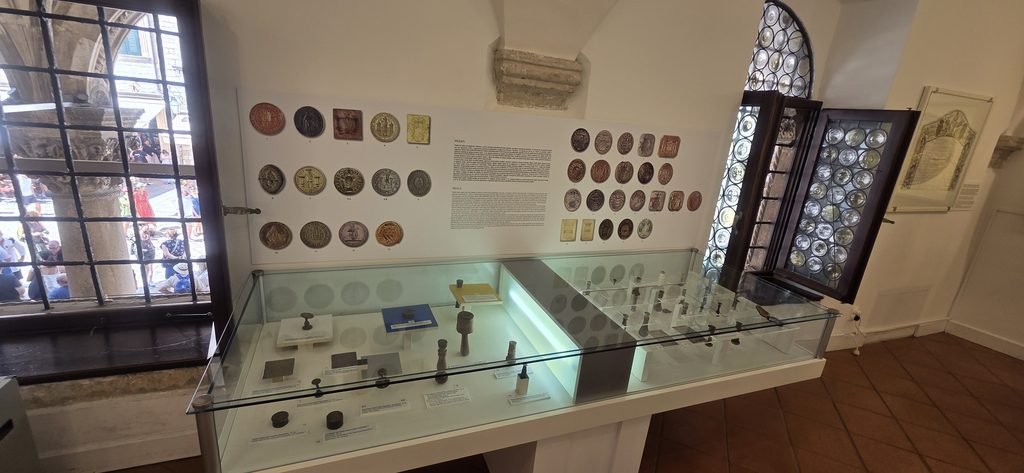
Our photographs include historical seals, coins, heraldic objects, and administrative items associated with the Republic.
These exhibits show how Dubrovnik expressed political authority and maintained its civic identity.
Coins and Official Seals
Commercial activity depended on recognized systems of payment, documentation, and measurement.
Coins and seals formed part of that administrative world.
For readers interested in the wider economic context, our article on the Republic of Dubrovnik’s commercial success explores the relationships and institutions that helped support its prosperity.
Noble Family Coats of Arms
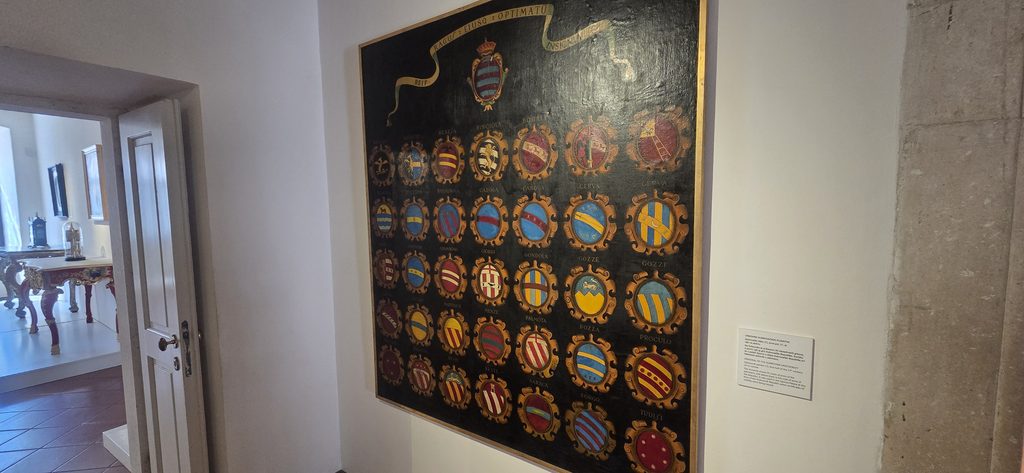
Heraldic symbols identified Dubrovnik’s aristocratic lineages.
They expressed family identity, inheritance, and social position.
Understanding these symbols also helps explain a political system in which hereditary noble families occupied the highest offices.
St. Blaise and the Republic’s Symbols
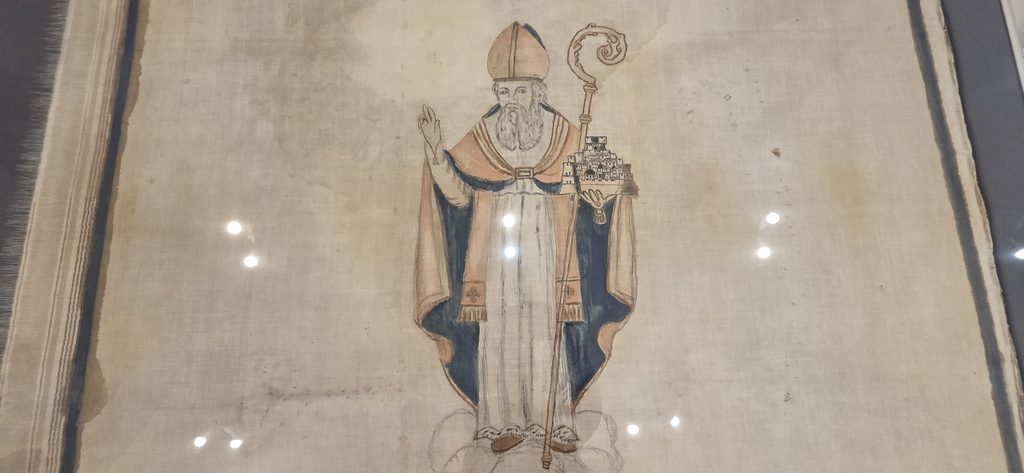
St. Blaise, Dubrovnik’s patron saint, played an important role in the city’s public identity.
His image appeared on flags, coins, seals, and other representations of civic authority.
Religion and political symbolism were closely intertwined in Ragusan society.
St. Blaise remains one of Dubrovnik’s most recognizable symbols today.
The Original Zelenci: Dubrovnik’s Famous Bell Tower Figures
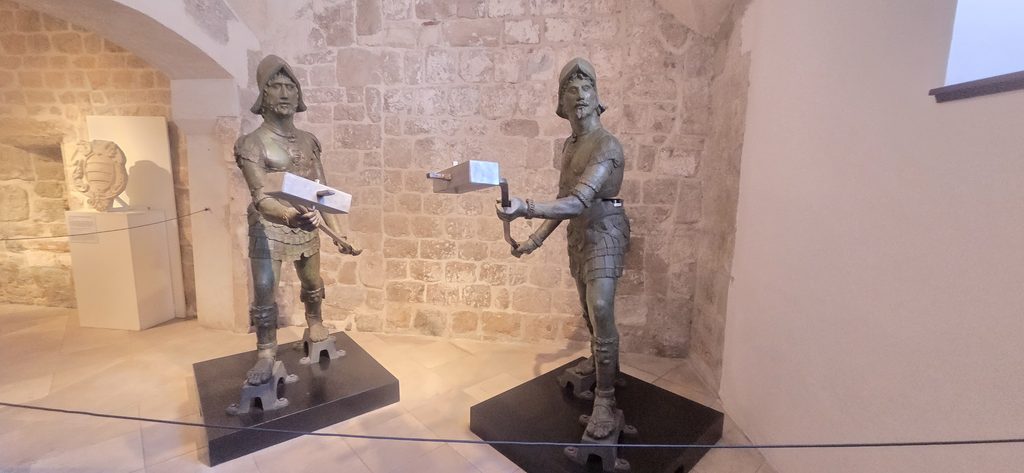
One of the museum’s most distinctive treasures is the pair of Renaissance bronze figures known as the Zelenci, popularly called Maro and Baro.
Dating to approximately 1478, the figures are associated with a design attributed to Michelozzo and were cast in the workshop of his collaborator Michele di Giovanni of Fiesole.
They originally struck the bell on Dubrovnik’s City Bell Tower.
Their familiar name, meaning the Green Ones, refers to the green patina that developed on the bronze.
The originals are preserved inside the museum, while replicas stand on the Bell Tower today.
This makes the figures particularly rewarding to see.
Visitors can examine the historic sculptures at close range and later look toward the tower to see their replacements continuing the tradition.
A local guide’s tip: Compare the original Zelenci inside the museum with the replicas on the Bell Tower. It is a wonderful way to connect an object preserved indoors with Dubrovnik’s living heritage.
A Historic Painting of Ragusa: Seeing Dubrovnik Through Different Eyes
One of our photographs captures a historical painted view of the city with the name RAGVSA displayed above the settlement.
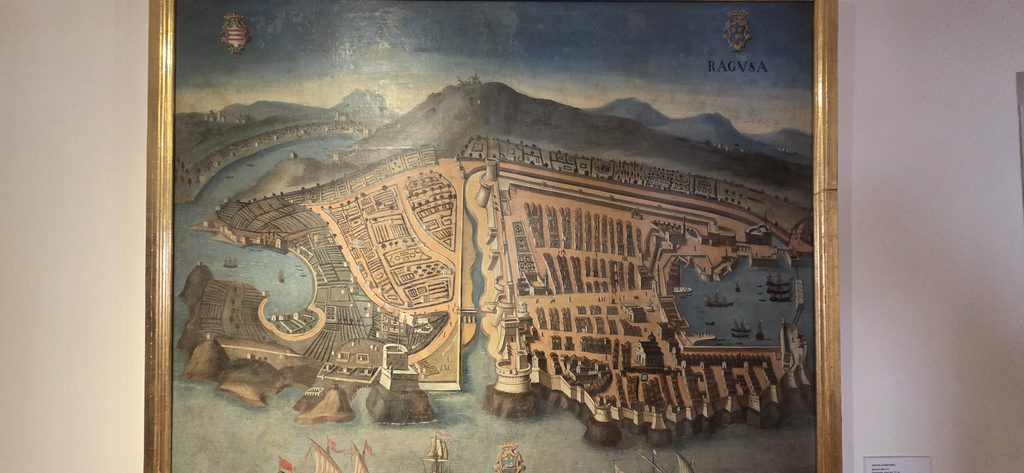
The painting presents Dubrovnik’s fortifications, harbor, surrounding landscape, and ships.
It offers an evocative picture of the city as a working maritime community rather than simply a modern travel destination.
For centuries, the Old Port was a place of commercial activity, while the fortifications protected the Republic’s political and economic interests.
The painting allows visitors to compare the city’s historical appearance with the Dubrovnik they see today.
For anyone interested in the Republic’s past, it is well worth examining.
A View Through the Palace Windows: Dubrovnik Cathedral and the Old Town
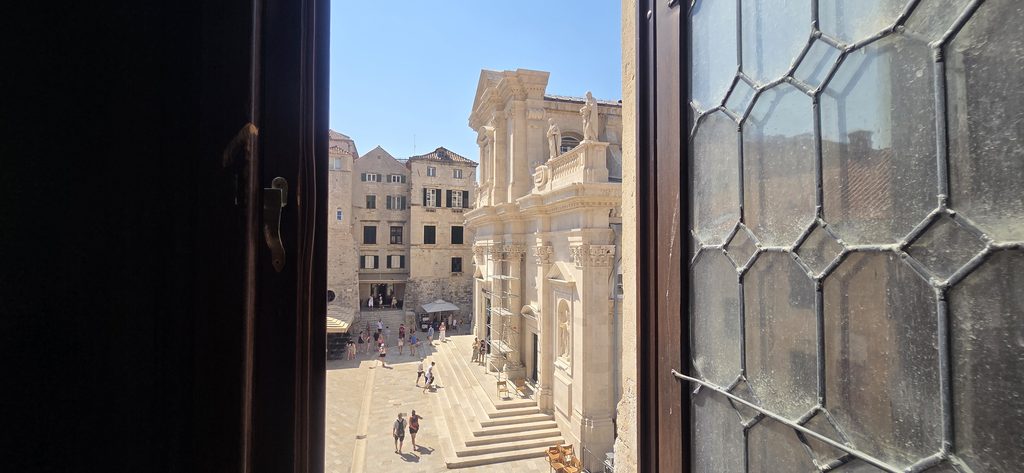
Not every memorable detail is displayed behind glass.
Some of my favorite photographs from our visit were taken through the palace windows.
One frames the beautiful Baroque façade of Dubrovnik Cathedral.
Another captures Dubrovnik’s stone buildings, red roofs, and blue sky through distinctive circular glass panes.
These views connect the museum interior with the city outside.
The palace stood within an interconnected landscape of churches, squares, commercial buildings, and government institutions.
Sometimes the view from one historic monument toward another reveals as much about Dubrovnik as an exhibition.
Art, Silverware, and Everyday Life in the Republic
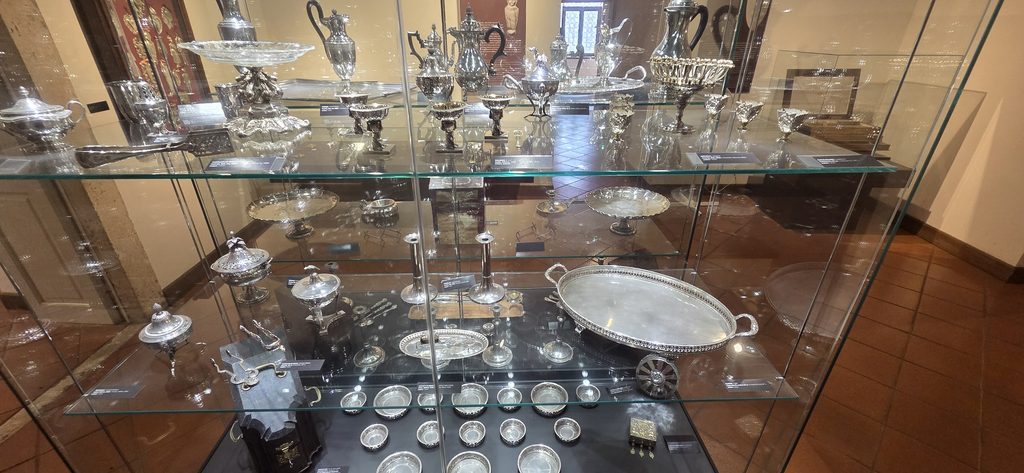
The museum’s collections offer a more personal understanding of Dubrovnik’s cultural history.
Historic portraits reveal changes in clothing, artistic taste, and social identity.
Decorative furniture, fine metalwork, and carefully crafted household objects reflect the tastes of wealthy families.
One of our photographs shows an impressive display of silverware, including trays, vessels, and other finely made pieces.
Another captures a small cannon mounted on a carriage bearing the name Ragusa.
The contrast is striking.
Elegant tableware reflects craftsmanship and domestic refinement, while artillery recalls the need to defend the Republic’s territory and interests.
Together, these objects reveal different dimensions of life within the same historical society.
Marin Getaldić: A Special Exhibition During Our August 2026 Visit
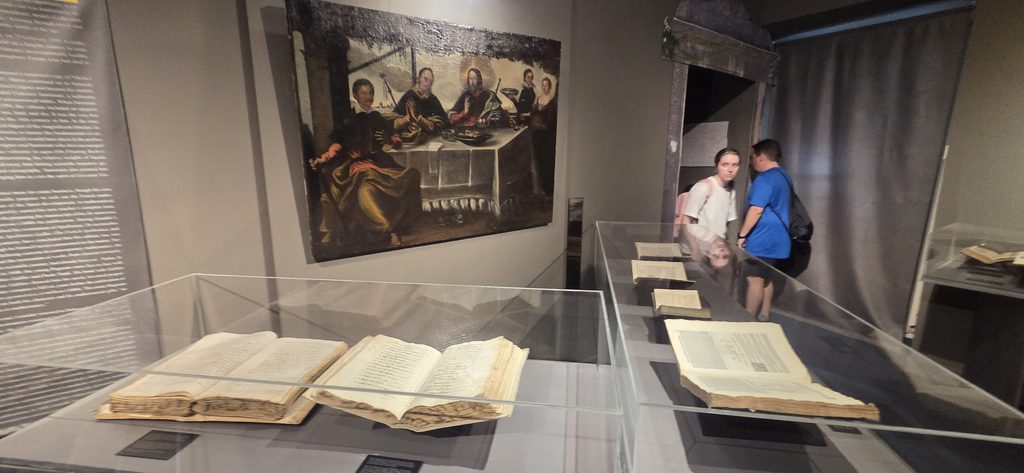
During our visit, the palace hosted a temporary exhibition dedicated to Marin Getaldić (1568–1626), one of Dubrovnik’s most distinguished mathematicians and scientists.
The exhibition, Marin Getaldić: On the 400th Anniversary of His Death, opened on June 19, 2026, and was scheduled to close on October 31, 2026.
Our photographs show historical books, documentary displays, and other material associated with the presentation.
Getaldić made important contributions to mathematics and optics, including work involving parabolic mirrors.
He also held public offices within the Republic.
His achievements remind us that Dubrovnik’s cultural heritage extends beyond architecture, diplomacy, and maritime commerce.
The city also produced scholars whose work contributed to wider European intellectual life.
This was a temporary exhibition we experienced in August 2026, not a permanent museum attraction.
Beyond the Palace: Discovering Dubrovnik’s Historic Center
The palace stands among monuments closely connected with the Republic’s history.
Nearby Sponza Palace reflects the city’s commercial and administrative heritage.
St. Blaise’s Church represents the enduring significance of Dubrovnik’s patron saint.
The Cathedral recalls centuries of religious and artistic patronage.
The Old Port illustrates the maritime connections that helped sustain the city.
Stradun, Dubrovnik’s principal street, provides another perspective on public life. Our local guide to Stradun and its historic landmarks explores these connections in greater detail.
The Franciscan Monastery, historic pharmacy, and cloister offer another fascinating glimpse into Dubrovnik’s cultural and intellectual traditions.
Together, these landmarks reveal how the city’s government, commerce, religious institutions, and everyday life formed part of an interconnected historical landscape.
Visiting Rector’s Palace Dubrovnik: Tickets, Opening Hours, and Local Advice
Located at Pred Dvorom 3, in the heart of Dubrovnik’s UNESCO-listed Old Town, the palace is just steps from St. Blaise’s Church and the Cathedral.
Rector’s Palace Opening Hours
Summer season — April 1 to October 31
9:00 AM – 6:00 PM, daily.
Winter season — November 1 to March 31
9:00 AM – 4:00 PM, closed on Mondays.
The museum is closed on Christmas Day, New Year’s Day, and the Feast of St. Blaise on February 3.
On Christmas Eve and New Year’s Eve, opening hours are 9:00 AM–12:00 PM.
Check the official Dubrovnik Museums opening hours before visiting.
Rector’s Palace Ticket Prices
Dubrovnik Museums currently publishes the same admission prices for summer and winter.
Individual Rector’s Palace tickets:
- Adults: €15
- Schoolchildren and students: €8
- Family ticket: €35, valid for up to two adults and their children aged 14 or younger.
Combined ticket for ten museums and galleries:
- Adults: €20
- Schoolchildren and students: €10
- Family ticket: €45, valid for up to two adults and their children aged 14 or younger.
The combined ticket is valid for seven days from the first museum visit and permits one entry to each participating institution.
Who Can Visit for Free?
Dubrovnik Museums offers free admission to several categories of visitors:
- Children under seven.
- Residents of Dubrovnik-Neretva County.
- Members of ICOM and HMD.
- Students of the University of Dubrovnik, RIT Croatia, and Libertas International University in Dubrovnik, from October through June.
Visitors should bring the necessary proof of eligibility where required.
Museum ticket offices accept cashless payments only.
For current prices and admission conditions, consult the official Dubrovnik Museums ticket information.
Is Rector’s Palace Included in the Dubrovnik Pass?
Yes. Admission to the Cultural History Museum inside Rector’s Palace is included in the Dubrovnik Pass.
The pass also provides access to Dubrovnik’s City Walls, Lovrijenac Fortress, and participating cultural attractions.
One-day, three-day, and seven-day options are available.
For visitors planning to explore several attractions, the pass may provide better value than purchasing individual tickets.
Our complete guide to the Dubrovnik Pass explains the available options and how to plan your sightseeing.
Check the latest conditions on the official Dubrovnik Pass website.
How Long Should You Spend Inside?
Allow approximately 45–60 minutes for a comfortable museum visit.
History enthusiasts and those interested in the architecture, paintings, and historical collections may prefer 60–90 minutes.
A Local Guide’s Advice: When Is the Best Time to Visit?
An earlier visit can be particularly pleasant during the summer season, although crowd levels vary depending on cruise ship arrivals, weather, and special events.
The museum is also an excellent cultural option during rainy weather or exceptionally hot afternoons.
For more practical advice, explore our local guide to avoiding crowds in Dubrovnik.
Accessibility and Photography
The palace is a historic building with staircases and rooms on different levels.
Visitors with reduced mobility should contact Dubrovnik Museums in advance to confirm current accessibility arrangements.
Photography rules may vary according to exhibitions. Always follow museum signs and staff instructions.
Experience Rector’s Palace with a Local Guide
The palace is particularly rewarding when its political history is understood alongside the surrounding Old Town.
A private historical walking tour with VipWalk Dubrovnik can provide that context before your museum visit, connecting the palace with the political institutions, maritime traditions, and historic streets of the former Republic.
For travelers who would like to explore the interiors in greater depth, a customized VipWalk experience can be arranged, subject to museum admission, scheduling, and availability.
Is Rector’s Palace Worth Visiting If You Have Only One Day in Dubrovnik?
If you’re visiting Dubrovnik on a cruise ship, your time ashore may be limited, but you don’t have to miss the city’s fascinating history. Our private Dubrovnik shore excursions are designed around your ship’s schedule, combining the Old Town’s most important landmarks, including Rector’s Palace, with relaxed pacing, personal attention, and carefully planned return timing.
Absolutely, especially for travelers interested in architecture, political history, and historic interiors.
The City Walls reveal how Dubrovnik defended itself.
The Rector’s Palace reveals how it governed itself.
These two attractions provide complementary perspectives on the Republic’s history.
Travelers planning to explore the fortifications can find additional advice in our guide to Dubrovnik’s City Walls.
If you have only a few hours in Dubrovnik, an exterior introduction during a private historical walking tour can provide useful context without requiring a longer museum visit.
For those with more time, exploring the interiors adds an entirely different dimension to the experience.
Frequently Asked Questions About Rector’s Palace Dubrovnik
What is Rector’s Palace in Dubrovnik?
Rector’s Palace is a historic government building in Dubrovnik’s Old Town, Croatia. It served as the official residence of the rector and an important administrative and judicial center of the Republic of Ragusa. Today, it houses the Cultural History Museum.
Where is Rector’s Palace located?
It is situated at Pred Dvorom 3, in the eastern part of Dubrovnik’s Old Town, near St. Blaise’s Church, the Cathedral, and the Old Port.
Why is Rector’s Palace historically important?
The palace represents the Republic of Ragusa’s political institutions, civic ideals, and architectural heritage. It was a center of government and the rector’s official residence, while its museum collections illustrate centuries of Dubrovnik’s social and cultural history.
Why did Dubrovnik’s rector serve for only one month?
The short mandate helped prevent excessive concentration of authority in one person. The rector represented the Republic while operating within a system of councils and established political restrictions.
Was Dubrovnik a democracy?
Not in the modern sense. The Republic’s highest political offices were held by members of hereditary noble families, and much of the population was excluded from governing institutions.
What architectural styles can be seen in Rector’s Palace?
The building combines Gothic and Renaissance features, with later Baroque elements introduced through successive phases of reconstruction and restoration.
What can visitors see inside the Cultural History Museum?
Visitors can explore the atrium, rector’s apartment, historic state and reception rooms, courtroom, former prison, chapel, paintings, portraits, coins, seals, decorated sedan chairs, silverware, weapons, and other collections.
Who was Miho Pracat?
Miho Pracat was a merchant, sea captain, and benefactor from the island of Lopud. He is remembered as the only commoner honored with a public monument by the Republic of Ragusa during its existence. His bust stands in the palace courtyard.
What are the Zelenci?
The Zelenci, popularly called Maro and Baro, are two Renaissance bronze bell-striking figures dating to approximately 1478. Their originals are preserved in the Cultural History Museum, while replicas stand on Dubrovnik’s City Bell Tower.
How much does admission to Rector’s Palace cost?
Individual tickets cost €15 for adults and €8 for schoolchildren and students. A family ticket costs €35. Combined tickets for ten museums and galleries are also available.
Is Rector’s Palace included in the Dubrovnik Pass?
Yes. Admission to the Cultural History Museum is included in the Dubrovnik Pass, subject to the pass’s current validity and conditions.
What are the opening hours in summer and winter?
From April 1 through October 31, the museum is open daily from 9:00 AM to 6:00 PM. From November 1 through March 31, it is open from 9:00 AM to 4:00 PM and closed on Mondays.
Are ticket prices different in summer and winter?
No. Dubrovnik Museums currently publishes the same admission prices throughout the year. Opening hours change seasonally.
How long does a visit take?
Allow approximately 45–60 minutes for a comfortable visit. Travelers interested in detailed historical collections may prefer 60–90 minutes.
Is the museum suitable for families?
Yes. The historic rooms, decorated sedan chairs, original Zelenci figures, and stories about the rector’s unusual role can make the museum especially interesting for children who enjoy history.
Can I visit Rector’s Palace with a private guide?
Yes. A historical walking tour can introduce the palace’s political and architectural significance from the exterior. A customized interior visit can also be arranged in advance, subject to museum admission, scheduling, and availability.
Discover Dubrovnik with a Private Local Guide
Rector’s Palace offers a fascinating glimpse into the political, cultural, and everyday life of the former Republic of Ragusa. Its story becomes even more meaningful when explored alongside the historic streets, churches, government buildings, and maritime landmarks that surround it.
At VipWalk Dubrovnik, our Private Old Town Walking Tour — Whispers of the Past connects these remarkable places through engaging historical storytelling and a deeply local perspective.
For cruise guests who prefer to explore Dubrovnik entirely their own way, our fully customized private Dubrovnik shore tour allows you to choose the places, experiences, and pace that suit you best. Whether you would like to spend more time discovering Rector’s Palace, explore the Old Town’s hidden corners, or combine history with panoramic viewpoints, we can create a personal itinerary around your interests and time in port. Museum admission and interior visits can be arranged in advance, subject to availability.
For travelers wishing to explore the palace interiors in greater depth, we can arrange a customized private experience, subject to admission, scheduling, and availability.
Every VipWalk tour is exclusively private, led by a licensed local guide, and tailored to your interests and preferred pace. Complimentary local concierge assistance is included before and during your stay.
For visitors particularly interested in Ragusan diplomacy, trade, and governance, our Business Walking Tour of Dubrovnik offers another way to explore the Republic’s history.
Discover our private Dubrovnik walking tours and experience therectors-palace-dubrovnik-obliti-privatorum-inscription.png Old Town beyond the ordinary.
VipWalk Dubrovnik — Discover Beyond the Ordinary.