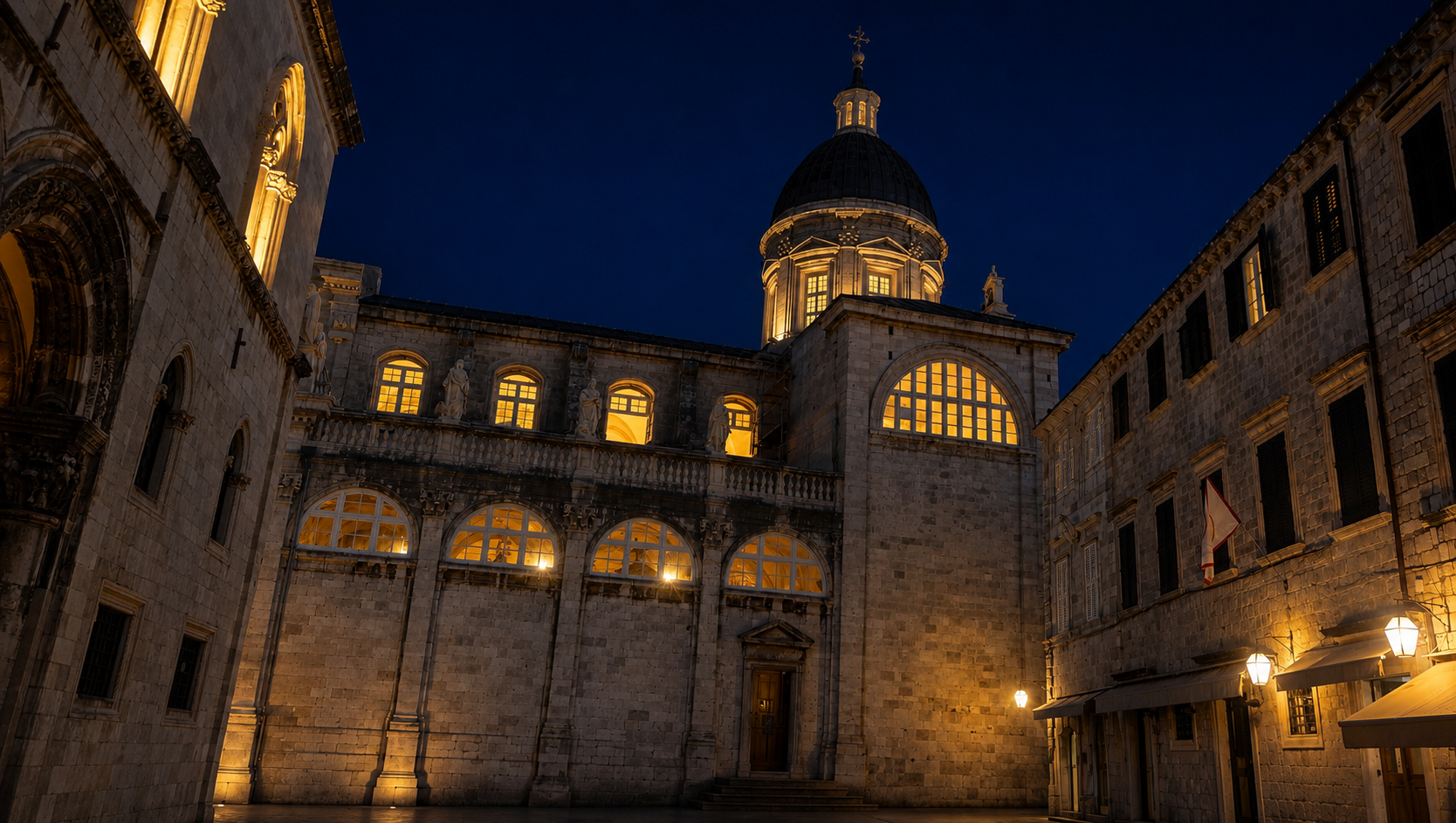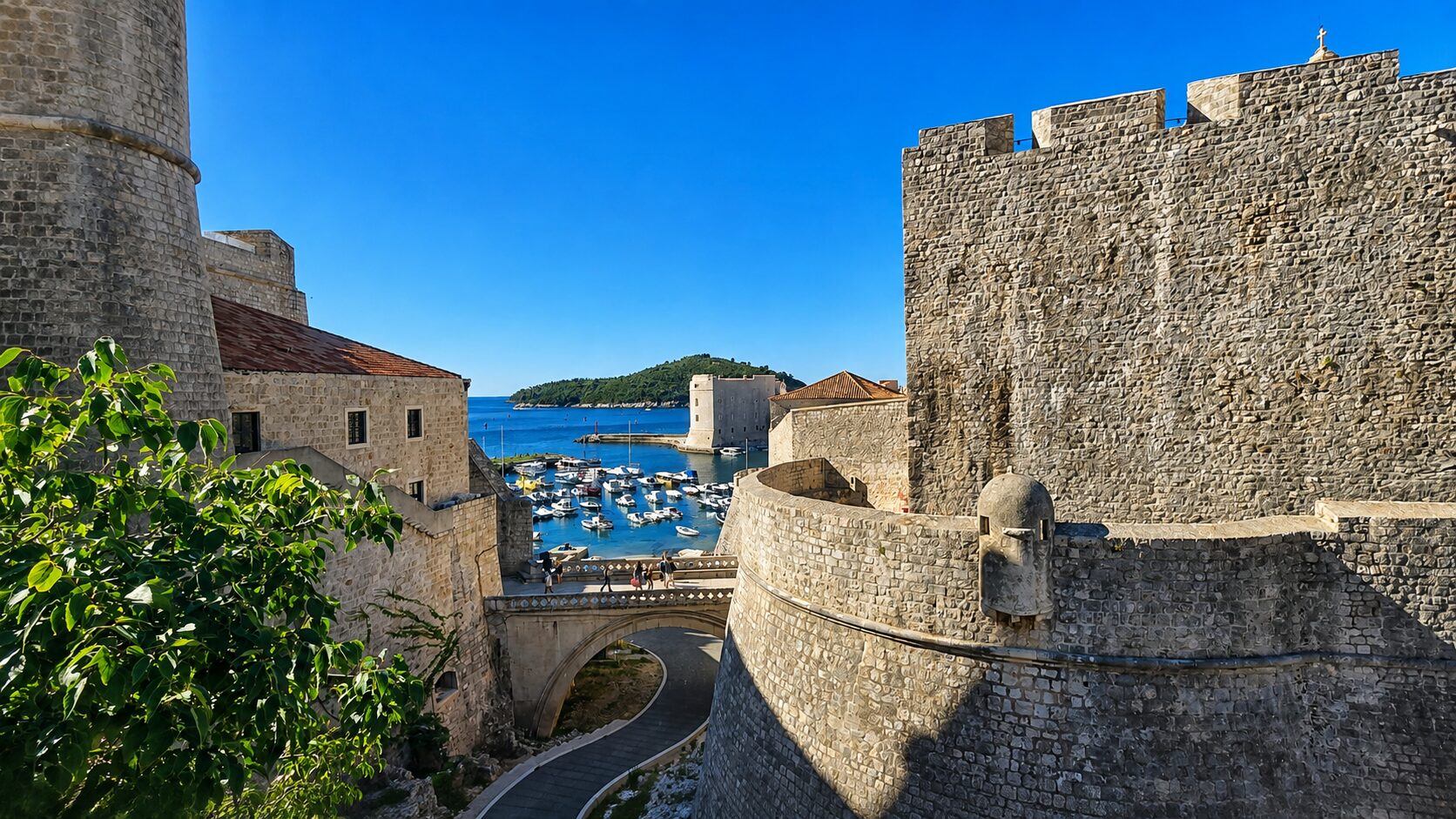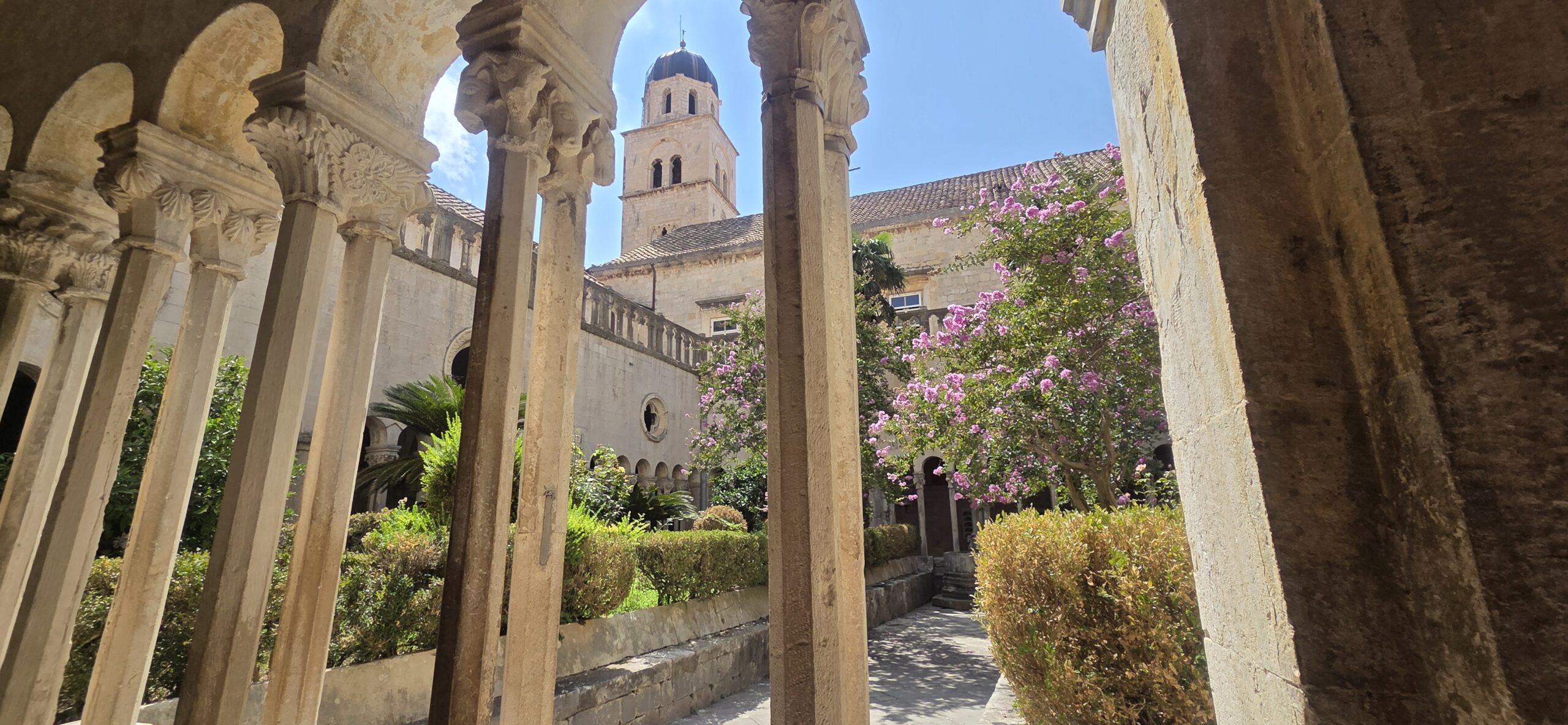
Just inside Pile Gate, where Stradun begins, the Franciscan Monastery Dubrovnik reveals one of city’s most fascinating contrasts: a centuries-old pharmacy tradition, a remarkable Romanesque-Gothic cloister and peaceful gardens only steps from one of the city’s busiest streets.
Many visitors walk past its stone façade without realizing what is inside.
Behind it, you can trace centuries of Dubrovnik through medicine, architecture, religion, art and everyday life — all within a remarkably compact part of the Old Town.
The monastery is also home to a pharmacy traditionally dated to 1317, with a centuries-long tradition that continues today.
That combination is what makes the Franciscan Monastery Dubrovnik one of the places I particularly enjoy showing my guests.
Is the Franciscan Monastery Dubrovnik Worth Visiting?
Yes. If you have 20–40 minutes, it is one of the most rewarding compact cultural stops in Dubrovnik Old Town, especially if you are interested in historic pharmacy, architecture, art or quieter places away from the main flow of visitors.
Quite a few of my guests enter expecting the Old Pharmacy to be the main attraction.
Then we reach the cloister.
I have had guests simply stop and say that they had no idea such a peaceful space existed behind the façade. One couple I guided was especially interested in the pharmacy, but by the end of the visit they told me that sitting beside the garden and studying the different capitals had become one of their favourite moments in Dubrovnik.
That reaction is exactly why I like this place.
Not every memorable Dubrovnik experience needs to be a panoramic viewpoint or a famous monument.
Sometimes it is a courtyard you almost walked past.
Quick Facts About the Franciscan Monastery Dubrovnik
- Location: Western end of Stradun, just inside Pile Gate
- Main highlights: Historic pharmacy, Romanesque-Gothic cloister, gardens and museum
- Pharmacy tradition: Traditionally dated to 1317 and continuing today
- Cloister: 120 columns and 12 large supporting pilasters
- Visit length: Around 20–40 minutes for most visitors
- Best for: History, architecture, medicine, art and quieter Old Town sightseeing
- Dubrovnik Pass: The Franciscan Monastery Museum is included in the Dubrovnik Pass
- Before visiting: Check current opening hours and admission conditions
How I Would Visit the Franciscan Monastery
If you have about 20 minutes:
Walk through the cloister and garden and give the historic pharmacy collection priority.
If you have 30–40 minutes:
Add the museum and spend more time looking at the carved capitals, pharmacy equipment and historic objects.
If you love architecture:
Slow down in the cloister. The capitals are different from one another, so looking closely is far more rewarding than simply taking one photograph.
If you are interested in medicine:
Give extra time to the pharmacy collection, old equipment and pharmaceutical manuscripts.
If you are visiting from a cruise ship:
Include the monastery naturally in a Pile Gate → Stradun → Old Town route rather than making a separate trip.
The Franciscans and Dubrovnik
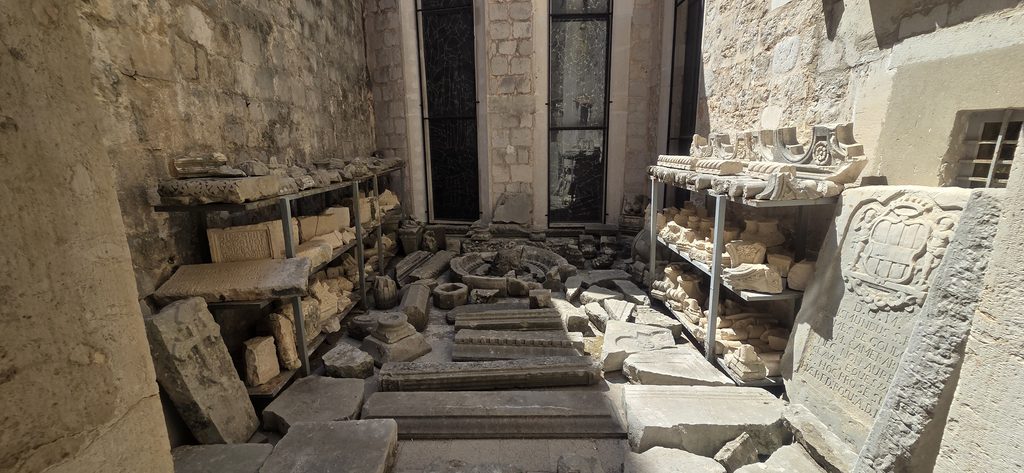
The Franciscans were present in Dubrovnik before the present monastery was constructed.
Their earlier monastery stood outside the city walls in the Pile area. In the early 14th century, during a period of concern about the city’s security, the community moved inside the fortified walls.
Construction of the present monastery began in 1317.
The establishment of the pharmacy is also traditionally associated with that year, although surviving historical records do not allow its exact foundation date to be established with complete certainty.
Over the centuries, the complex survived fires, rebuilding and earthquakes. The catastrophic 1667 earthquake caused extensive destruction, and much of the church was later reconstructed in the Baroque style.
Important earlier elements survived.
That combination of architectural periods is useful when trying to understand Dubrovnik because the Old Town is rarely the product of just one historical moment.
Look Up Before You Enter: The Franciscan Church and Pietà
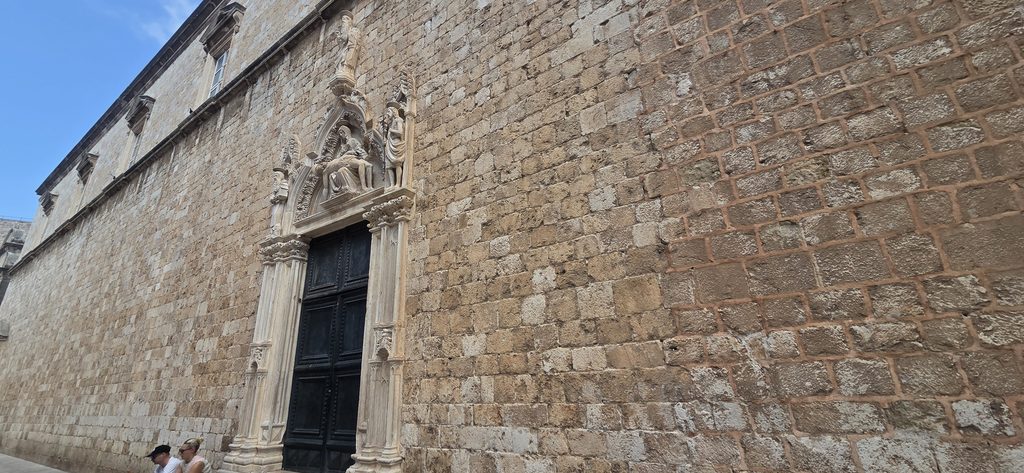
Before entering the monastery, stop outside and look above the church entrance.
It is very easy to miss.
The Gothic south portal was created in 1498 by the Dubrovnik sculptors Leonard and Petar Petrović, with a beautiful Pietà incorporated into its decoration.
The portal is one of the important surviving elements of the earlier church, which was heavily damaged in the 1667 earthquake.
Step Inside the Franciscan Church
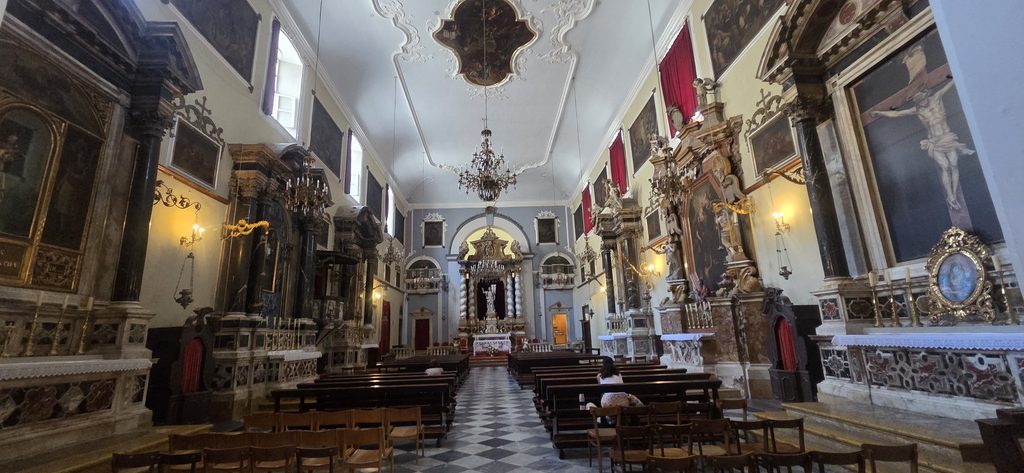
During my tours, we do not stop only at the famous Pietà outside. We also step inside the Franciscan Church itself, and the contrast often surprises my guests.
The original church was heavily damaged in the 1667 earthquake, and the interior we see today was rebuilt in the Baroque style. Rich altars, paintings and religious sculpture create a very different atmosphere from the medieval cloister that follows.
I have seen guests enter expecting only a quick church visit and then stop to look much more carefully at the artwork.
The church also contains the tomb of Ivan Gundulić, one of Dubrovnik’s most celebrated writers, adding another connection between the Franciscan complex and the city’s cultural history.
The Romanesque-Gothic Cloister
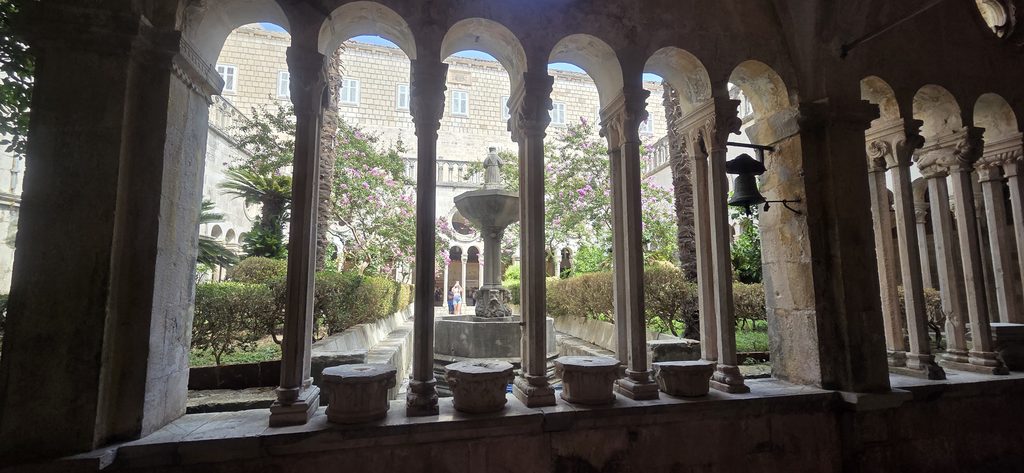
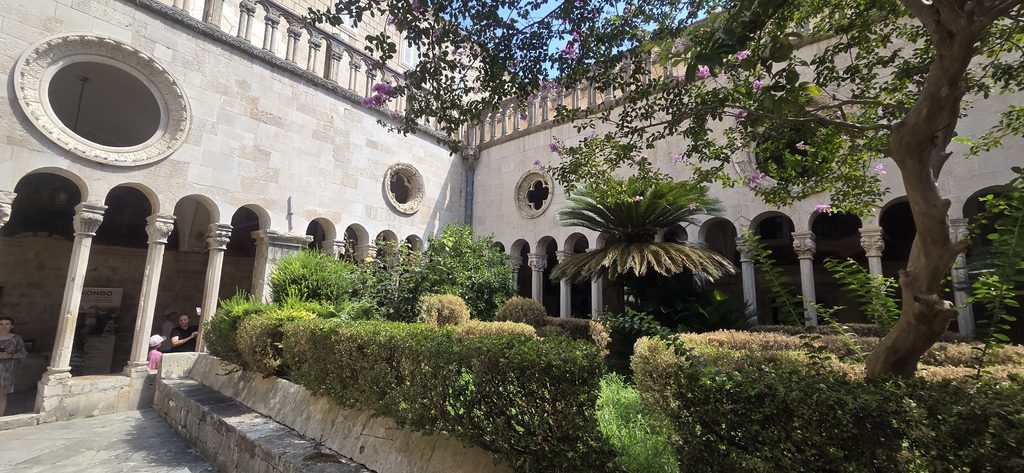
The Romanesque-Gothic cloister is one of my favourite architectural spaces in Dubrovnik.
It is associated with the builder Mihoje Brajkov of Bar and is considered one of Dubrovnik’s finest examples of late Romanesque architecture, with Gothic elements appearing in its forms and decoration.
The cloister contains 120 slender columns and 12 large supporting pilasters.
But the numbers are not what make it memorable.
Look at the capitals.
They are not all identical.
You will discover carved plants, animals, human figures and geometric forms.
I have had guests who were not especially interested in architecture suddenly spend ten minutes comparing carved faces and animals once they realized how different the capitals are.
Local guide tip: Don’t take your photograph immediately. Walk around the cloister first and look closely at several capitals. Once you begin noticing the details, the entire courtyard becomes much more interesting.
The Gardens Inside the Franciscan Monastery
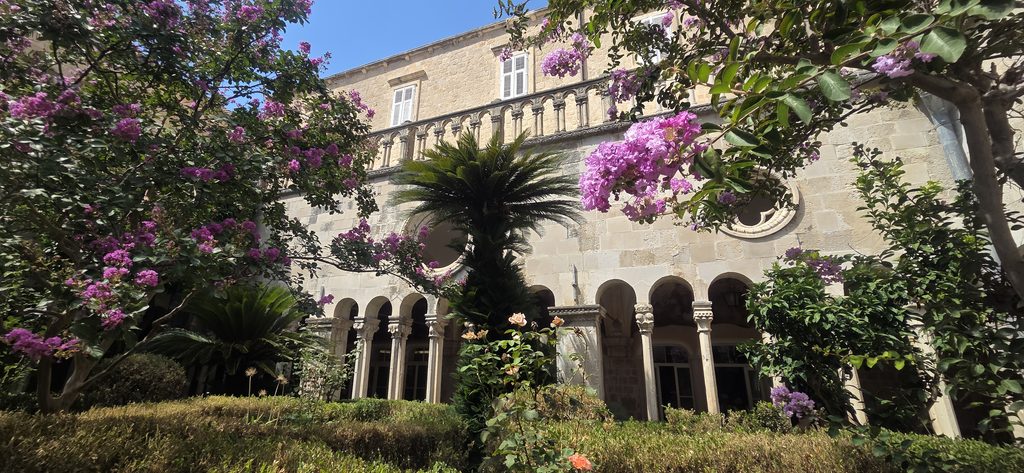
For many visitors, the greenery is one of the unexpected pleasures of the monastery.
The Franciscan complex contains two cloister gardens and a larger upper garden, creating one of the most significant surviving green spaces within Dubrovnik’s city walls.
The contrast is beautiful.
Outside: Stradun, footsteps, voices and the rhythm of one of Dubrovnik’s busiest streets.
Inside: stone arcades, greenery, shade and a completely different atmosphere.
The connection between the gardens and pharmacy history is especially interesting.
Medicinal plants played an important role in traditional monastic medicine. Before modern pharmaceutical production, remedies had to be prepared from ingredients that were dried, crushed, distilled, measured and combined.
Standing beside the garden makes that history much easier to imagine.
One comment I hear surprisingly often from guests is:
“I didn’t expect this to be my favourite part.”
I understand why.
It is not dramatic.
It is simply beautiful and calm.
For guests who prefer a gentler sightseeing pace, this can also be a lovely place to pause within an Old Town route. My guide to Dubrovnik for senior travelers explains how I usually approach more comfortable sightseeing without removing the important historical stops.
The Franciscan Pharmacy and Its 1317 Tradition
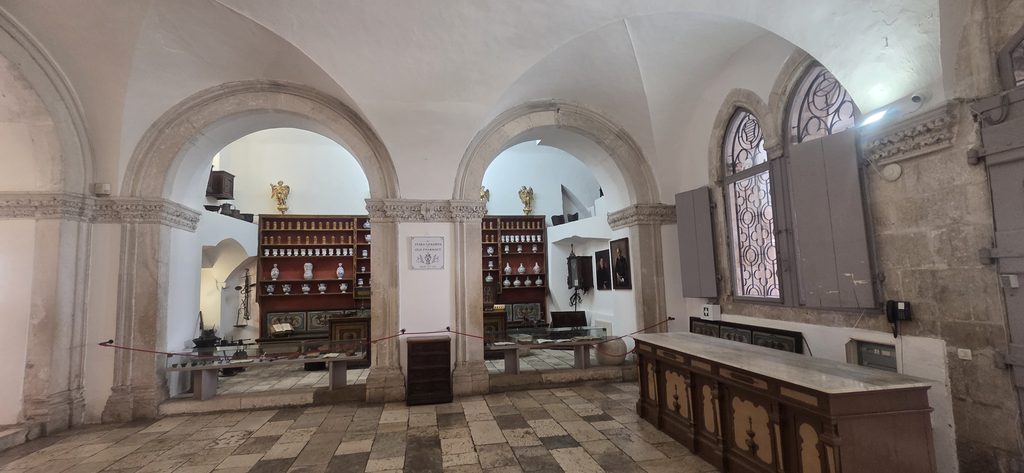
The pharmacy is the monastery’s most famous historical feature.
Its foundation is traditionally dated to 1317.
It is widely regarded as one of Europe’s oldest pharmacy traditions, but I prefer not to concentrate too much on rankings.
What makes it truly remarkable is easier to understand: pharmaceutical activity has been associated with this monastery for centuries, and a pharmacy at the site continues that tradition today.
Originally, the pharmacy primarily served the Franciscan community.
Over time, it also served Dubrovnik’s citizens.
That detail matters because it shows that the monastery was not a closed world disconnected from city life.
The pharmacy therefore helps answer one of the questions I often discuss with guests:
What was everyday life in Dubrovnik actually like centuries ago?
The Pharmacy Is Still Working Today
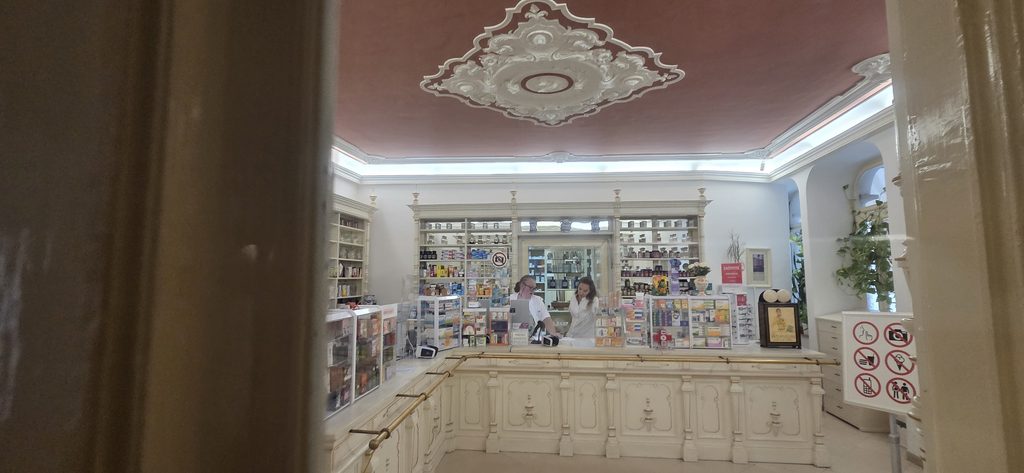
One of the details that surprises guests most is that the pharmacy story did not end with the historic collection.
A modern pharmacy now operates at the site and continues the pharmaceutical tradition, while the museum preserves the historic Franciscan pharmacy collection.
Visitors can also buy traditional cosmetic preparations made according to old recipes. These include products based on ingredients such as rose, rosemary, lavender, almond oil and wax, together with traditional creams and scented waters.
For some of my guests, this becomes an unexpected Dubrovnik souvenir.
The story feels much more tangible when you realize that the pharmacy tradition did not simply stop and become something behind glass.
There is still a living connection with it today.
The Museum and Historic Pharmacy Collection
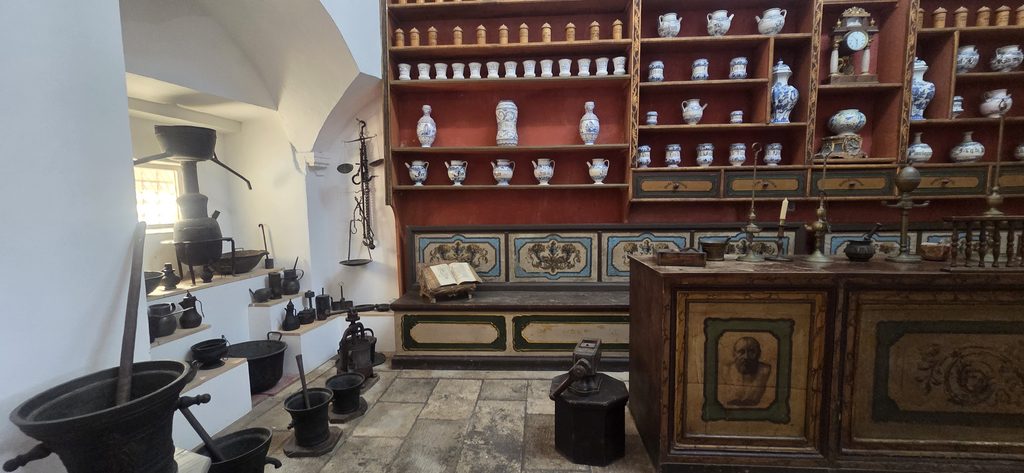
The museum gives you a much clearer idea of how medicines and preparations were once compounded.
Among the collection are historic pharmacy furniture, ceramic vessels from Siena and Florence, mortars, presses, scales and old distillation equipment.
The collection also preserves pharmaceutical manuscripts with precise measurements, offering an unusually direct glimpse into how preparations were actually made rather than simply what an old pharmacy looked like.
That distinction matters.
An early pharmacy was not simply a shop selling finished medicines.
It was a place where ingredients were weighed, crushed, mixed and distilled with considerable care.
The museum also contains religious art, manuscripts, liturgical objects and numerous architectural fragments.
I particularly like the stone fragments displayed throughout the museum.
A carved capital.
A piece of decorative stonework.
A fragment of a building altered or damaged centuries ago.
Individually, they may appear modest.
Together, they remind us that historic cities are not frozen in one perfect moment.
Buildings are damaged, rebuilt and adapted, and sometimes a museum fragment is the only physical clue left from an earlier Dubrovnik.
Old Pharmaceutical Recipes — Including Some Very Human Ones
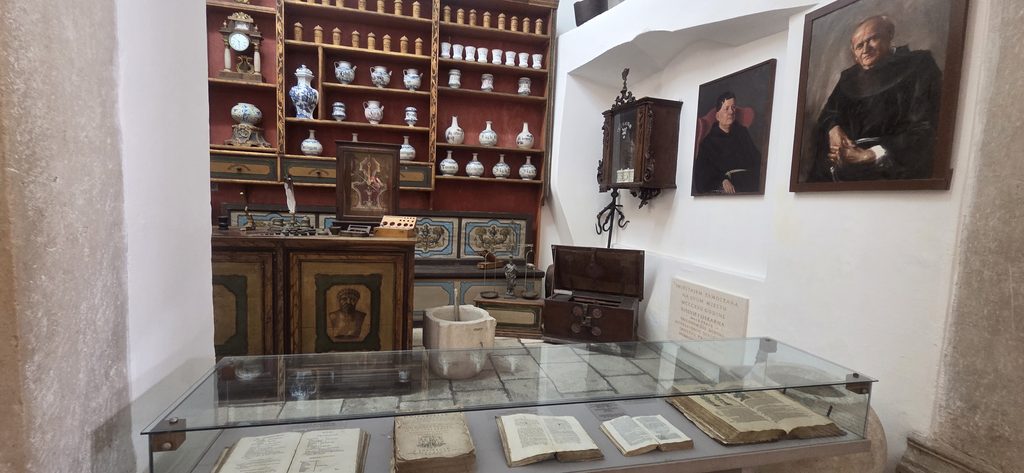
The monastery preserves an extensive collection of pharmaceutical manuscripts and historical recipes.
Some preparations are exactly what you would expect: balms, oils, powders, ointments and medicinal mixtures.
Others are much more entertaining.
Historical descriptions mention preparations associated with an elixir of youth, remedies intended to improve memory and even a preparation supposedly useful for maintaining peace in a marriage.
That one normally gets the biggest reaction.
I sometimes ask couples on my tours whether they would like me to find the recipe for them.
It usually gets a laugh.
These small details make history easier to remember because the concerns of people living centuries ago were not always so different from ours.
Health.
Ageing.
Memory.
Relationships.
The packaging changes.
People do not change quite as much.
What the Franciscan Monastery Tells Us About the Dubrovnik Republic
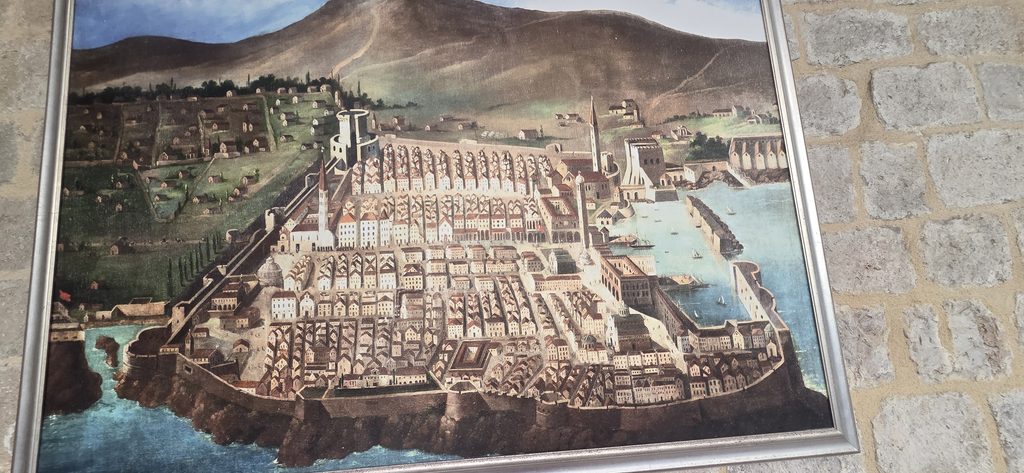
The monastery is also a useful place for understanding something larger about the former Republic of Ragusa.
Dubrovnik’s history is often told through its City Walls, diplomacy, maritime trade and wealthy palaces. But the Republic also depended on institutions that made everyday urban life possible.
Health care was part of that story.
The pharmacy began within a religious community, yet over time its role extended beyond the friars to the people of Dubrovnik. That reflects a city in which religious institutions, public life, knowledge and practical services were closely connected.
Dubrovnik’s commercial and diplomatic links also placed the city within wider Mediterranean networks of people, books and ideas. The pharmaceutical manuscripts and knowledge preserved here are one small reflection of those connections.
For me, this is why places such as the Franciscan Monastery matter.
They show that the history of the Dubrovnik Republic was not only about rectors, merchants and defensive walls.
It was also about how people lived, learned, cared for one another and organized life inside a small but remarkably sophisticated city.
A Quieter Side of Dubrovnik Old Town
Dubrovnik is visually spectacular: City Walls, fortresses, palaces, the Adriatic and panoramic viewpoints.
The Franciscan Monastery offers something different.
Instead of looking across the whole city, you start looking closely — at a carved face, an old pharmacy jar, a manuscript or a fragment of stone.
That change of scale is part of what makes the monastery memorable.
If you enjoy this quieter side of the city, early morning in Dubrovnik Old Town offers a similar atmosphere before the busiest part of the day begins.
Is the Franciscan Monastery Included in the Dubrovnik Pass?
Yes. The Franciscan Monastery Museum is included in the Dubrovnik Pass, together with several other important cultural attractions in the Old Town.
If you are already planning to walk the City Walls or visit several museums, it is worth checking whether the Pass makes financial sense for your itinerary rather than purchasing each admission separately.
I explain what is included, how the different versions work and when it is actually worth buying in my complete guide to the Dubrovnik Pass.
Local guide tip: Decide what you genuinely want to visit before buying a pass. The Dubrovnik Pass can be excellent value for an active sightseeing day, but there is no advantage in rushing through attractions simply because they are included.
How Long Do You Need at the Franciscan Monastery Dubrovnik?
For most visitors, 20 to 40 minutes is enough.
If you mainly want to see the cloister, gardens and pharmacy collection, a shorter visit works well.
If you are particularly interested in architecture, historic medicine or religious art, you can easily stay longer.
Local guide tip: Don’t rush directly to the pharmacy exhibits. Walk through the cloister first, look at the capitals and spend a few moments beside the garden. Then explore the museum and pharmacy collection. The sequence makes the story easier to understand.
Is the Franciscan Monastery Good for Senior Travelers?
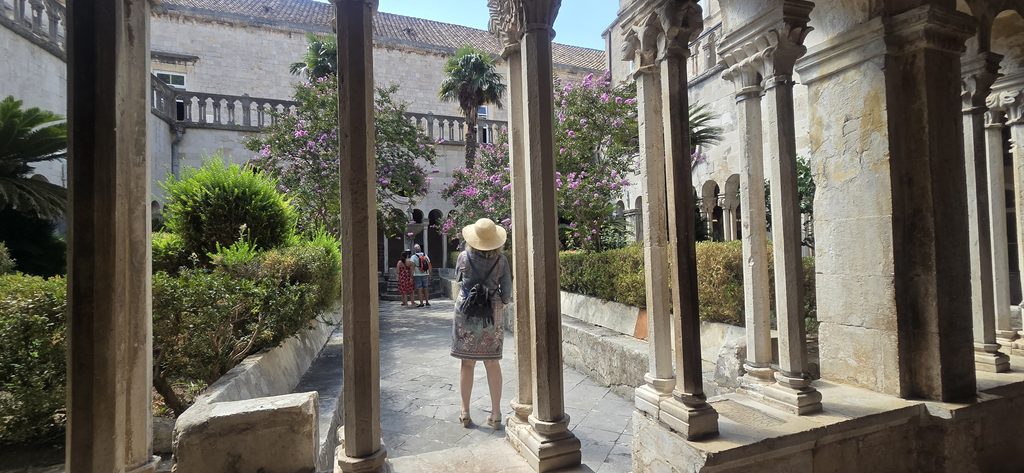
For many senior visitors, yes.
Its location close to Pile Gate and Stradun makes it convenient to combine with sights in the lower part of the Old Town.
The cloister also gives visitors a natural opportunity to slow down during a walking route.
Of course, individual mobility needs differ, and historic buildings can include thresholds, uneven surfaces and access limitations.
For that reason, I prefer adapting the overall route rather than describing any historic monument as completely stair-free or universally accessible.
If you are planning a more comfortable visit, my Dubrovnik guide for senior travelers explains how I approach easier Old Town routes, pacing, stairs, shade and practical sightseeing choices.
Should You Include It in a 4-Day Dubrovnik Itinerary?
Yes, especially if you have more than one day in Dubrovnik.
You do not need to treat the monastery as a separate half-day attraction.
It fits naturally into an Old Town morning.
For a longer stay, my perfect 4-day Dubrovnik itinerary shows how I prefer to divide the Old Town, City Walls, viewpoints, sea and nearby experiences without rushing everything into the first day.
Franciscan Monastery for Cruise Ship Guests
The monastery works particularly well for cruise passengers because of its location.
If you have only a few hours ashore, include it naturally in a Pile Gate → Franciscan Monastery → Stradun → Luža Square → Old Port route rather than treating it as a separate destination.
That gives you a meaningful cultural stop without losing time on unnecessary transportation.
On my custom private Dubrovnik shore tours, I include places like this when they genuinely suit the interests of the guests and the time available, while always keeping the ship’s schedule in mind.
Visiting the Franciscan Monastery With Me
I do not include the Franciscan Monastery in exactly the same way on every tour.
That is intentional.
Some guests are fascinated by the Old Pharmacy.
Others want to understand historic medicine.
Some love architecture and begin examining the capitals.
Others are interested in religious history.
And some simply fall in love with the garden.
One of the best parts of private guiding is noticing what catches someone’s attention and changing the emphasis accordingly.
Sometimes we stay longer because someone becomes fascinated by the pharmacy equipment.
Sometimes a guest starts photographing every unusual capital.
And sometimes everyone simply wants to enjoy the garden for a few extra minutes.
Those are often the moments people remember.
The monastery can be included naturally in my private Dubrovnik Old Town walking tour when it matches the interests of the guests.
VipWalk guests also receive my Dubrovnik Concierge Service, so I can help with practical questions before and during your stay — from timing and restaurants to deciding what is genuinely worth adding to your itinerary.
Practical Information
Where is the Franciscan Monastery?
At the western end of Stradun, immediately inside Dubrovnik Old Town near Pile Gate.
What can you see?
The Franciscan Church, Romanesque-Gothic cloister, gardens, museum, historic pharmacy collection and the modern working pharmacy.
How long should you allow?
Around 20–40 minutes for most visitors.
Is it included in the Dubrovnik Pass?
The Franciscan Monastery Museum is included in the Dubrovnik Pass.
Who will enjoy it most?
Visitors interested in Dubrovnik history, architecture, pharmacy, medicine, religious art and quieter cultural places.
When should you visit?
Earlier in the day can be more comfortable during busy summer periods, although conditions vary.
Do you need to check opening hours and admission?
Yes. Both can change, so I recommend checking current official information shortly before visiting rather than relying on older prices or schedules found online.
Frequently Asked Questions About the Franciscan Monastery Dubrovnik
What is the Franciscan Monastery Dubrovnik famous for?
It is best known for its Romanesque-Gothic cloister, historic pharmacy tradition, monastery gardens and Franciscan Museum.
How old is the Franciscan Pharmacy in Dubrovnik?
The pharmacy is traditionally dated to 1317 and is regarded as one of Europe’s oldest pharmacy traditions. Its most remarkable feature is the centuries-long continuity of pharmaceutical activity associated with the site.
Is the Franciscan pharmacy still working?
Yes. A modern pharmacy operates at the site today and continues the pharmaceutical tradition, while the museum preserves the historic Franciscan pharmacy collection.
Can you buy traditional products at the Franciscan pharmacy?
Yes. Visitors can buy traditional cosmetic preparations made according to old recipes, including creams and scented waters using ingredients such as rose, rosemary and lavender.
Is the Franciscan Monastery included in the Dubrovnik Pass?
Yes. The Franciscan Monastery Museum is included in the Dubrovnik Pass. If you plan to visit the City Walls and several other museums or attractions, it is worth comparing the Pass with individual admission costs.
What can I see inside the Franciscan Monastery?
Visitors can see the Franciscan Church, Romanesque-Gothic cloister, gardens, museum, historic pharmacy collection, religious art, manuscripts and carved stone fragments.
How many columns are in the Franciscan cloister?
The cloister has 120 slender columns and 12 large supporting pilasters. Many capitals feature different decorative motifs, including plants, animals and human forms.
Is there a garden inside the Franciscan Monastery?
Yes. The Franciscan complex contains two cloister gardens as well as a larger upper garden, creating an unusual green space within Dubrovnik’s historic walls.
How long does it take to visit the Franciscan Monastery Dubrovnik?
Most visitors need around 20 to 40 minutes, although travelers particularly interested in pharmacy history, art or architecture may want to stay longer.
What is the best time to visit the Franciscan Monastery?
Earlier in the day can be particularly pleasant during the busy summer season. However, the cloister and gardens provide a very different atmosphere from the streets outside at almost any time.
Is the Franciscan Monastery worth visiting?
Yes, especially if you enjoy history, architecture, historic medicine, religious art or quieter places inside Dubrovnik Old Town. If your sightseeing time is extremely limited and your only priorities are the City Walls and major viewpoints, you may choose to leave it for another visit.
Is the Franciscan Monastery suitable for senior visitors?
For many senior travelers, yes. Its central location makes it convenient to include in a gentler Old Town itinerary, although individual mobility requirements and access conditions should always be considered.
Is the Franciscan Monastery close to Pile Gate?
Yes. It is immediately inside the western entrance to Dubrovnik Old Town, beside the beginning of Stradun.
Can cruise passengers visit the Franciscan Monastery?
Yes. Its location near Pile Gate makes it particularly easy to include in a Pile Gate–Stradun–Old Town shore itinerary without adding another transfer once you reach the historic centre.